
The Sketchbook-Journal Hybrid: Combining Drawing and Writing in One Notebook
Most people keep drawing and writing in separate books, or keep neither. A single notebook that holds both turns out to be more honest about how a mind actually works.
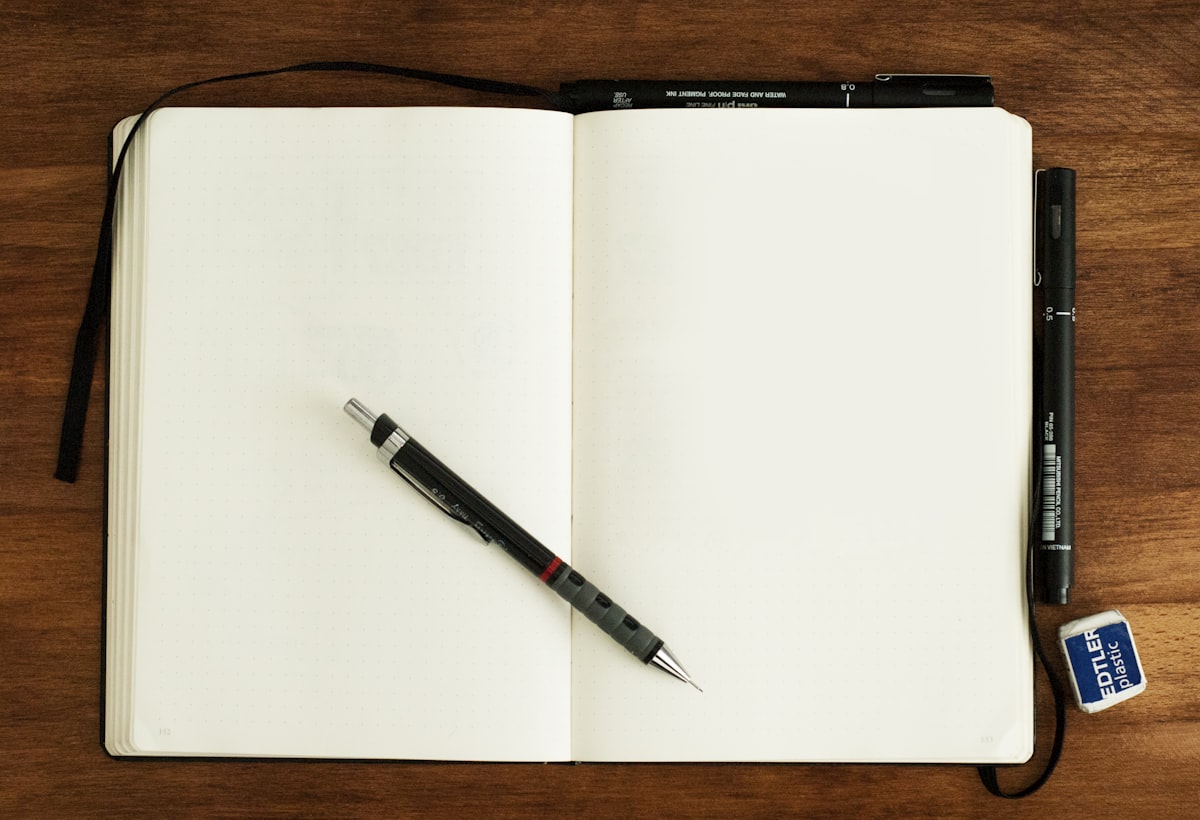
There is a particular kind of person who owns a beautiful empty sketchbook and a half-used diary, and uses neither well. The sketchbook is too precious to draw badly in. The diary is for words, and the day a small drawing wants to happen, there is nowhere obvious to put it.
The hybrid notebook solves a problem most people did not know they had. One book, no rules about which page does what, drawing and writing allowed to sit side by side or tangle together on the same spread.
It sounds like a small thing. In practice it changes how you use the page, because it stops asking you to decide in advance what kind of thought you are about to have.
Why the Separation Was Never Natural
The split between sketchbook and journal is a habit of organization, not a fact about how minds work.
Your attention does not arrive sorted into words and images. You notice the shape of a building and the feeling it gives you in the same moment. You think through a problem and the clearest version of the thought turns out to be a diagram, not a sentence. You write half a paragraph about a conversation and realize what you actually want is to draw the person's hands.
When the tools are separated, you lose those moments. The thought that wanted to be a drawing gets forced into words, or abandoned because the sketchbook is in another bag. The hybrid removes the gap between the impulse and the page. Whatever the thought is, it has somewhere to land.
This matters more than it sounds, because the friction of choosing the right book is often enough to lose the thought entirely.
What the Hybrid Actually Looks Like
There is no single correct form. People who keep one tend to land somewhere along a spectrum.
At one end, the pages alternate loosely — a written entry here, a drawing there, sequenced by whatever the day brought rather than by any plan. The book reads like a record of attention, words and images taking turns.
At the other end, words and drawings share the same spread and comment on each other. A sketch of a street with a sentence underneath about why you stopped. A page of writing with a small diagram in the margin that says the thing the paragraph was circling. The two modes are not separated at all. They are two ways of finishing the same thought.
Most people move between these without deciding to. That mobility is the point. You are not maintaining two practices in one book. You are letting a single practice use whichever language fits the moment.
Choosing the Book Itself
This is the one place where the paper matters, because the two activities have different needs.
Writing wants a surface that is smooth enough for a pen to move quickly and thin enough that the book does not become a brick. Drawing, especially anything wet, wants heavier paper that does not buckle or bleed through.
A mixed-media notebook is the usual compromise. The paper is heavier than standard journal stock — somewhere around 90 to 120 gsm — which handles pen, pencil, light watercolor, and ink without much bleed, while still being pleasant to write on. It will not satisfy a serious painter, and it is slightly slower under a pen than thin writing paper. For a hybrid practice, that trade is almost always worth making.
Avoid anything too beautiful. A notebook you are afraid to ruin is a notebook that stays empty. The right hybrid book is good enough to enjoy and cheap enough to fill without ceremony.
The Real Obstacle Is Not Skill
People who hesitate at the hybrid usually say the same thing. They cannot draw.
This misunderstands what the drawing is for. You are not making art for anyone. You are using line the way you use handwriting — as a fast, private way of recording something that words would handle worse. A rough sketch of how a room was arranged, a quick map of an idea, the gesture of a tree you walked past. None of it needs to be good. It needs to be yours, and it needs to be true to what you saw.
The same loosening applies in the other direction. People who think of themselves as visual often freeze at the written pages, certain their words will be clumsy. They will be, at first, and it does not matter. The notebook is not graded.
What kills a hybrid book is treating either page as a performance. The drawing page is not your portfolio. The writing page is not your manuscript. Both are working surfaces, and working surfaces are allowed to be messy.
How to Start Without Overthinking It
The simplest way in is to stop planning the page before you reach it.
Open the book. Begin with whatever the moment gives you. If a sentence arrives, write it. If an image arrives, draw it. When you reach the edge of what one mode can do, switch. The paragraph that runs out of words can finish as a sketch. The drawing that needs explaining can carry a line of text beneath it.
A few habits help the practice settle:
Date the pages, lightly. A hybrid book becomes far more interesting in retrospect when you can see what a given week actually held — the run of words during a hard stretch, the sudden cluster of drawings when something caught your eye.
Let spreads be mixed. Resist the urge to keep drawings on one side and words on the other. The most useful pages are often the ones where both happen at once.
Keep one pen and one pencil with the book, and nothing else. The fantasy of a full kit is another way of not starting. You can add tools once the habit exists.
Leave the bad pages in. The instinct to tear out a weak drawing or an embarrassing entry undermines the whole thing. The book works because nothing in it has to be defended.
What Changes Over Time
The first benefit is practical. You stop losing thoughts to the wrong container. Whatever shape an idea arrives in, it has somewhere to go.
The second is slower and more interesting. A hybrid book becomes a fairly honest map of your attention — not just what you thought, but how you thought it. Read back through a few months and you notice that certain subjects always pull you toward drawing, and others always come out as words. The things you sketch tend to be the things you want to hold still and look at. The things you write tend to be the things you are trying to work out.
That distinction is worth knowing about yourself. It tells you something about how your mind actually processes the world — what it wants to observe and what it wants to argue with.
The third change is the loosening itself. People who keep a hybrid book for a while tend to become less precious about both activities. The drawing gets freer because it is no longer trying to be good. The writing gets freer because it no longer has to carry the whole weight of a thought alone. Each mode relaxes because the other is always available as a release valve.
A Book That Matches How You Think
The hybrid notebook is not a technique so much as a permission. It says that you do not have to know, before you sit down, whether the next thing is a drawing or a sentence. You can find out on the page.
Most of us were taught to separate these — words in one place, pictures in another, and a quiet sense that the two belong to different parts of life. A single notebook that holds both is a small correction to that. It treats your attention as one thing, expressed in whatever language fits the moment.
Pick up a book with paper good enough for both. Put a pen and a pencil beside it. The next time something catches your attention, do not decide in advance how to record it. Let the page tell you, and follow it.
Was this article helpful?
Thanks for your feedback!


