
Mixed Media Journaling: Combining Writing, Art, and Collage in One Practice
A practical guide to keeping a journal that holds writing, drawing, paint, and collage on the same page — what to use, how to start, and how to keep it from feeling chaotic.
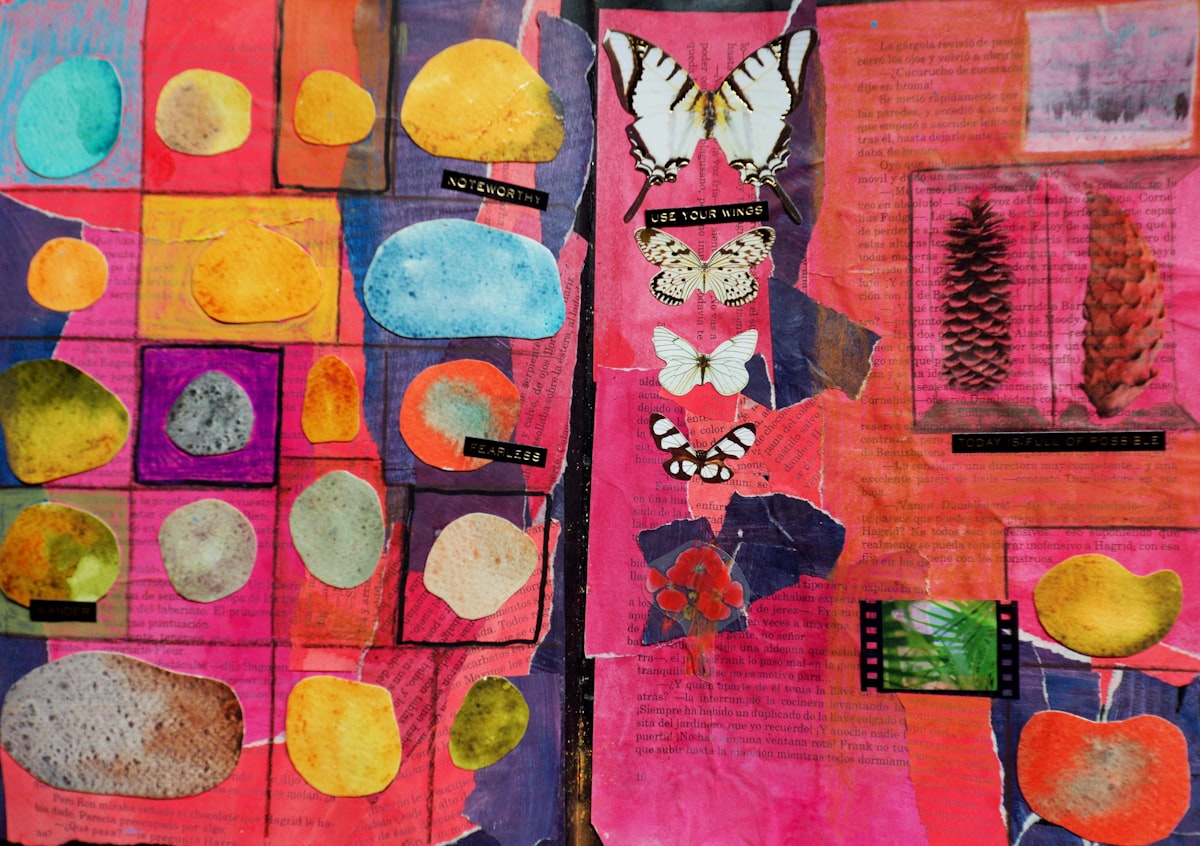
What Mixed Media Journaling Actually Is
Mixed media journaling is the practice of using more than one material on the same page. Writing sits next to a watercolor wash. A magazine clipping is glued in beside a sketch. A scrap of fabric, a pressed leaf, a stamp, a line of handwriting. The page becomes a small surface where several different ways of recording your life are allowed to coexist.
It is not a craft project. It is not scrapbooking. The pages do not need to be beautiful or finished, and they are not made for an audience. What separates mixed media journaling from purely visual or purely written practices is simply that you do not commit to one mode. The medium that suits the moment is the one you reach for.
For people who have tried written journaling and felt it was missing something, or tried art journaling and felt the absence of words, this hybrid practice is often the format that finally feels right.
Why Combine the Two
Writing is good at certain things. It is precise. It can hold an argument with itself. It can name something that has been nagging at you for a week and put it on the page in a way you can examine.
Images are good at other things. They hold mood. They hold the look of a particular afternoon. They preserve what your eye noticed when you were not yet able to say why.
When you keep them in separate notebooks, you tend to default to whichever one is easier on a given day. When you put them on the same page, they begin to comment on each other. A sentence becomes more specific because it sits next to a sketch of the actual room. A drawing becomes more meaningful because of the few words written beneath it.
The point is not that mixed media is better than either practice on its own. The point is that some experiences need both, and a mixed media journal is the only place where you do not have to choose.
What You Need to Begin
A starter kit for mixed media journaling is smaller than most people expect.
A notebook with paper that can take some abuse. Standard journal paper buckles under wet media and tears under glue. You want paper rated for mixed media, watercolor, or sketching — typically 100 gsm or higher, ideally 200 gsm if you plan to use paint. Hardcover bindings hold up better than flexible covers when pages get thicker with collage.
A reliable black pen. A waterproof fineliner is the most flexible single tool. It writes cleanly, survives light water-based color, and works for both prose and sketching. One good pen does more for your practice than a drawer of mediocre ones.
A small set of color. Pick one. Colored pencils are forgiving and dry. Watercolor in a small travel palette covers a lot of ground with little equipment. Markers are fast but bleed through thin pages. Choose what feels least intimidating and start with twelve colors or fewer.
A glue stick. This is the bridge between writing and collage. With a glue stick you can attach magazine pages, photographs, ticket stubs, fabric, packaging, and torn paper. A glue stick is enough; rubber cement and PVA come later if at all.
A pair of small scissors. Optional but useful, especially if you plan to cut shapes from printed material rather than tearing.
That is the whole kit. You can fit it in a small pouch and carry it. Anything beyond this is an addition you make once you know what your practice actually needs.
Setting Up the Notebook
The blank first page of a mixed media journal can stop a practice before it begins. The notebook feels precious. Anything you put on the first page feels like a declaration.
The simplest cure is to deliberately spoil it. Put a few color swatches on the first page. Write a date and one sentence about what you hope this notebook will become. Glue something in — a receipt, a torn piece of paper, anything. The first page does not need to be a portrait of the practice. It just needs to break the spell of the perfect blank surface.
Some people leave the inside cover for a key — a small index of the colors they tend to use, or notes about what each section is for. Others ignore that entirely and let the notebook fill chronologically with no system. Either approach works.
What does not work is treating the notebook as a precious object. The pages are for use. They will get crinkled, smudged, layered, and partly obscured. That is the practice functioning normally.
A Simple Page Structure
A common mistake when starting mixed media journaling is to attempt every technique at once on a single page. The page becomes crowded, the layers fight each other, and the entry feels exhausting rather than expressive.
A more sustainable approach is to think of each page as having a quiet ground and a few deliberate marks on top.
The ground is whatever covers most of the page. It can be a wash of one color, a piece of patterned paper glued down, a page from an old book, or simply the white of the paper itself. The ground sets the temperature.
The deliberate marks are what you add. A few sentences of writing. A small sketch. A single photograph. A pasted scrap. The deliberate marks should be limited — three or four elements, not ten — because each one needs space to be readable.
If you start each entry by asking what the ground is and what the three or four elements on top will be, the pages tend to settle into something coherent without having to plan further.
Working in Layers
Mixed media is, almost by definition, layered. The order in which you put down the layers matters more than the materials themselves.
The general principle is wet to dry, light to dark, background to foreground.
Wet media — watercolor, ink wash, light acrylic — goes down first, because everything afterward sits on top more easily once the page is dry. If you put pen marks down and then wash water over them, the marks bleed unless your pen is genuinely waterproof.
Light colors go before dark ones. It is much easier to add darker accents on top of a pale wash than to recover a light area after dark color has covered it.
Collaged elements can go almost anywhere in the sequence, but they tend to anchor a page best when added once the ground is established. Glue something onto a wet page and you risk tearing both the page and the clipping.
Writing usually goes on last, because handwriting needs a stable surface to land on. Trying to write across a freshly painted page produces frustrated penmanship and unreadable lines.
You do not have to follow this order strictly. But when a page is not working, the cause is often that the layers were added in the wrong sequence — and the fix on the next page is simply to slow down and let one layer settle before the next.
What to Put on a Page
A few page formats are worth knowing because they give you somewhere to start when you are not sure what an entry should look like.
Single image, paragraph beneath. Glue or draw one image that fills most of the page. Below it, write a paragraph. The image carries what cannot be said in words; the paragraph carries the specifics.
Half and half. Divide the page into two roughly equal areas. One half is writing, the other half is image. Let them comment on each other without explaining each other.
Color field with text overlay. Cover the page in one or two colors. Write through the color in a contrasting pen. The color carries mood; the writing carries content.
Grid of fragments. Divide the page into six or nine boxes. Fill each box with one small thing — a tiny drawing, a word, a swatch, a stamp, a single sentence. Each box is a fragment of the day.
Layered scrap and sentence. Glue down two or three pieces of paper from different sources. Write a single sentence that ties them together, or sets them in motion.
You do not need a different format every time. Most people find two or three structures that suit their handwriting, their materials, and the way they think, and return to them with small variations.
Keeping It from Feeling Chaotic
The most common reason people abandon mixed media journaling is that the pages start to feel cluttered or out of control. A few constraints help.
Limit your palette per page. Pick two or three colors for an entry and stick with them. A limited palette across mixed materials reads as deliberate, even when the page is otherwise busy.
Leave white space. A page that is fully covered tends to feel suffocating. Empty areas of the paper give the eye somewhere to rest and let the marked areas matter more.
Do not try every material in one entry. Most strong pages use two or three media — say, pen and watercolor, or collage and pencil — not all of them at once.
Repeat elements within a page. A single color used in three places, a shape that appears twice, a line of writing that echoes a phrase elsewhere on the page. Repetition is what makes a layered page feel composed rather than chaotic.
Stop before you think the page is done. Most pages get worse in the last ten percent of the work, not better. If the page already has what it needs, leave it alone, even if it feels unfinished.
When Words Stop and Image Begins
A useful skill in mixed media journaling is knowing when to stop writing and let the visual carry the rest.
Words are good for what you can articulate. Image is good for what is still beyond articulation. If you find yourself writing the same kind of vague sentence three different ways, that is a signal. The thing you are trying to say may not yet be a sentence. It may be a color. A shape. A torn fragment. A face cut from a magazine.
Switching modes mid-entry is allowed. Stop the paragraph. Add a swatch of paint. Sketch what you cannot describe. The entry can return to writing afterward, or not. The page does not require a single voice.
This flexibility is part of why the practice works. You are not committed in advance to expressing a feeling in any particular medium. You let the feeling choose what fits.
Sources for Collaged Material
A common stall in mixed media journaling is not having anything to glue in. The fix is to collect over time, rather than search at the moment of writing.
A small folder or envelope kept near the notebook can hold scraps as they arrive — receipts you do not throw away, magazine pages you tore out for the colors, ticket stubs, small printed photographs, fragments of packaging, junk mail with interesting type, pages from books that were already falling apart.
When you sit down to a page, you reach into the folder. You do not need to find the perfect element. You need an element that has presence — a color, a face, a shape, a texture — that you can place on the page to anchor what you are doing.
Printed photographs from your phone work especially well. A single small photo from the past week, printed at any drugstore at wallet size, gives the page a specificity that drawing alone cannot provide. The photograph holds the actual look of a moment; the writing and other elements respond to it.
Pacing the Practice
A mixed media journal does not need to be filled daily. In fact, daily entries often exhaust the practice quickly because each page asks more of you than a written entry alone.
A more durable rhythm is once or twice a week, with longer entries that take twenty to forty minutes. On other days you might write a short text-only entry in a different notebook, or skip writing entirely. The mixed media notebook becomes a slower, deeper companion to your weekly thinking, not a daily obligation.
If you skip several weeks, do not catch up. Open the notebook to the next blank page and put something down. The gap is part of the record. Long stretches of white space are honest, and they often correspond to periods when your inner life had other places it needed to be.
A Few Common Pitfalls
Some mistakes recur for people new to mixed media. Knowing them in advance shortens the learning curve.
Buying too much before starting. A drawer of unused supplies does not produce a journal. Begin with the minimal kit. Add only when the existing materials are genuinely insufficient for something specific.
Trying to make every page beautiful. A mixed media journal will contain weak pages. Pages where the colors fight, the writing is dull, the collage feels random. The next page is always available. The cumulative practice is what matters.
Comparing pages to social media. The pages you see online are filtered, photographed in good light, and often posted only because they were the strong ones from a much larger pile. Real journals contain many pages that would never be shared.
Skipping the writing. Visual elements alone tend to lose meaning over time. Even a date and one sentence anchor a page enough that it remains readable to you years later.
Quitting because of one bad spread. One unsatisfying spread is part of any honest practice. Move on. Do not let a single page convince you the practice is not for you.
What This Practice Becomes
A mixed media journal kept consistently for a year is a different kind of object than a written journal of the same length. You can flip through it and see the year visually before you read any of it. The colors of the pages move with the seasons. Faces and places that mattered to you reappear. Particular weeks reveal themselves as denser pages, with more layers and more material. Quieter weeks show as plain text or simple swatches.
This kind of record is harder to summarize than a written one, but it is often easier to re-enter. A glance at a sketched page from a particular month brings back the feel of that month in a way that a paragraph of prose may not.
Mixed media journaling is not therapy, and it is not art. It is a way of recording your life with whatever serves the moment — words when words fit, images when images do, collage when something already made matters more than anything you could draw or say. The materials are not the practice. They are the means.
Begin with a notebook, a pen, a glue stick, and one set of color. Make a single page this week. Whatever it ends up being is enough.
Was this article helpful?
Thanks for your feedback!


