
Journaling for Artists: How Creative Practitioners Can Use the Page
Most artists have an inconsistent relationship with writing. Used well, a notebook becomes part of the studio, a tool for the questions the work itself cannot answer.
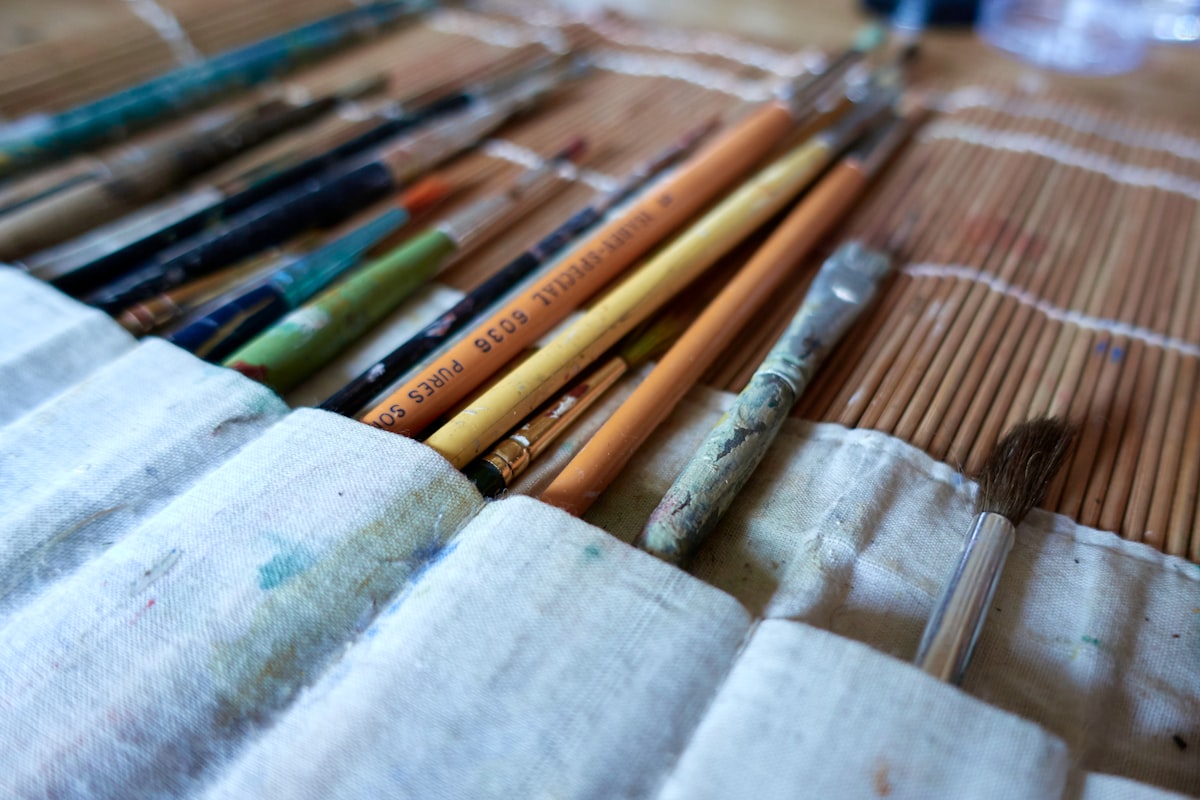
Most artists have a complicated relationship with writing. The studio is for making the thing. The notebook, if it appears at all, tends to be a cluttered mix of grocery lists, deadline reminders, and the occasional sketch. The idea of journaling as a separate, deliberate practice can feel like one more obligation in a life already organized around long hours of unpaid attention.
But almost every working artist eventually finds their way to some form of writing alongside their work. Not because anyone told them to. Because the studio, by itself, cannot answer certain questions. A notebook can.
This is not about journaling as therapy or self-help. It is about the page as a working tool — something that lives near your easel, your sewing machine, your laptop, your kiln. Used well, it becomes part of the practice rather than an addition to it.
What the Notebook Is For
The first useful distinction is what the artist's notebook is not.
It is not your finished work. It is not a portfolio piece. It is not a place to be precious. The pressure most artists already carry into their making does not need a second venue.
The notebook is the place where you work things out before, during, and after the actual making. You think about what you are trying to do. You note what surprised you. You ask why a piece is not landing the way you hoped, or why one moved further than you expected. You record the ideas that arrived while you were doing something else.
If your studio is where the work is made, the notebook is where the work is held. The two practices are different. They reinforce each other when you let them.
Generating, Not Just Recording
A common misuse of the artist's notebook is treating it purely as a record. Today I worked on this. Tomorrow I plan to do that. The light was good. I felt tired.
That kind of log has its place, but it leaves most of the value on the table. The notebook becomes far more useful when you treat it as a generating space — somewhere ideas can show up, get tested in writing, and either grow or be set aside.
A few practical ways this looks:
Writing toward a piece before you start it. Not a plan, exactly — more like a paragraph or two about what you are after. What the piece is trying to do. What it is reacting to. What you are afraid will go wrong. The act of articulating this in words sharpens what you actually intend, often in ways the visual or material thinking alone does not reach.
Writing about a piece in the middle of making it. When something stalls, the notebook gives you a way to step back without leaving the studio. You describe what you have so far. You name what is not working. You ask questions of the piece. Sometimes the answer arrives in the writing. Sometimes it arrives an hour later because you finally stopped circling.
Writing about a piece after it is finished, or abandoned. This is where pattern emerges. The third time you write about a project that died because you got bored halfway, you start to notice something about how you choose what to make. Or you notice that your strongest pieces all began with a constraint you set yourself. The notebook is how that information becomes visible to you.
Working Through the Blocks
Every working artist hits stretches where the work refuses to come, or comes only as a thinner version of what they want. The notebook is one of the few places where this state can be examined without having to also fix it.
Most blocks resolve faster on the page than in the studio because writing requires you to be specific. You cannot write "I am stuck" and stop. The page asks: stuck on what, exactly. Stuck how. Since when. What did you last manage to do, and what part of that felt alive. What are you afraid the work is, or is not.
The questions are simple, but the answers are often the first time you have actually looked at what is happening rather than reacting to it.
It also helps to remember that not every block is a problem to be solved. Some are the natural rhythm of a longer arc — you have just finished something, or your attention is already moving toward the next thing without your conscious awareness yet. The notebook is where you can tell the difference between a creative crisis and a fallow stretch you are mistaking for one.
The Studio Journal as Reference
Over time, an artist's notebook accumulates something a studio cannot: a continuous record of how the work has actually changed.
Most of us misremember our own progress. We tell ourselves we have been stuck for years when in fact, looking back, we were doing different work two years ago and the current frustration is about a more refined problem. We forget the experiments that did not lead anywhere visible at the time but turned out to be the seed of what we are doing now. We forget how something we now consider easy was, at one point, the thing we could not figure out.
A notebook returned to occasionally — not constantly, just every few months — gives you back this information. You see what you were thinking about a year ago. You see questions you had completely forgotten asking, some of which you have now answered without realizing it. You see what you were excited about and what you abandoned, and you start to recognize the shape of your own working life.
This is not nostalgia. It is data about your practice that is otherwise inaccessible.
What to Actually Write
There is no correct format. Some artists write in long paragraphs. Some keep terse, dated lists. Many move between modes depending on what is happening. What matters is that you write specifically enough that future-you can use it.
A few prompts that tend to be useful for working artists, drawn from things people actually find themselves writing about:
What am I trying to do with this piece, in plain words, right now. Not what it should mean or what it might be read as — what I am trying to do.
What is the thing I keep returning to. What images, materials, questions, or moods keep appearing across my recent work, even when I am not consciously choosing them.
What am I avoiding. Where in my practice am I steering around something — a medium, a subject, a level of difficulty, a kind of feedback — and what would happen if I went toward it instead.
What is the current edge of my skill. What can I almost do. What am I not yet able to do, but want to be able to do, and what is the smallest next step toward that.
What is the work asking of me that the rest of my life is making hard to give. Time, focus, courage, money, solitude, support — name it specifically rather than letting the frustration stay vague.
These do not need to be answered in order or all at once. One of them, written about for ten minutes once a week, is enough to shift how you see your practice over the course of a few months.
Visual and Written, Together
For visual artists, designers, and makers, the question often arises whether the notebook should be a sketchbook, a writing journal, or both.
There is no single right answer. Some artists keep them strictly separate, finding that the discipline of pure text in one and pure image in the other helps each mode stay sharp. Others mix them on every page, with sketches, swatches, and prose all sharing space. A growing number of people use a mix — a paper notebook for handwritten reflection, a digital sketchbook on a tablet, voice memos for ideas that arrive in transit.
What matters is that you do enough writing to actually benefit from the words, rather than letting the visual side absorb the entire space. It is easy, as a visual person, to default to drawing whenever the page is open. Drawing is valuable. So is the slower, more linear thinking that prose forces.
A simple rule, if you want one: at least once a week, write a paragraph about your work that contains no images. The constraint is what makes it useful.
Showing It to No One
The artist's notebook works best when you are clear with yourself that it is not for an audience.
This sounds obvious, and it is the part most often violated. The instinct to perform — to write as though someone smart and discerning might read it, to phrase things in a way that would sound right out loud — quietly creeps in. It makes the notebook less useful. The honest, awkward, half-formed thoughts are exactly the ones worth capturing, and they only land on the page if you are sure no one will ever judge them.
Some artists keep their notebooks deliberately ugly for this reason. Cheap paper. Unmatched pens. No attempt at calligraphy or layout. The lack of polish is protective. It signals to your inner critic that nothing here is being prepared for display.
If you find yourself writing for an imagined reader, name it on the page. "I notice I am writing this as though someone is looking." That sentence alone usually changes the rest of the entry.
A Small Practice, Steadily
You do not need a daily journaling practice to benefit from a notebook in your studio. Most working artists find that something less frequent works better — a longer entry once a week, or quick notes around the edges of working sessions, or a deliberate write-through after finishing a project.
What matters is that the page is available, and that you have actually used it enough times to know what it can do for you.
Begin with one entry this week. Write about whatever you are currently making, or wishing you were making, or unable to start. Write specifically. Stop when the words run out.
That is the entire practice. Over months, it accumulates into something that genuinely serves the work — not as therapy, not as journaling in the self-help sense, but as a tool you reach for the way you reach for any other instrument that helps you do what you are trying to do.
The notebook does not make the art. It makes you a clearer presence in front of the art you are already trying to make. For most working artists, that turns out to be enough.
Was this article helpful?
Thanks for your feedback!


