
Visual Journaling for Beginners: Adding Images, Sketches, and Color to Your Practice
A practical guide to building a visual journaling practice from scratch — what materials you actually need, how to start without artistic skill, and how to keep it sustainable.
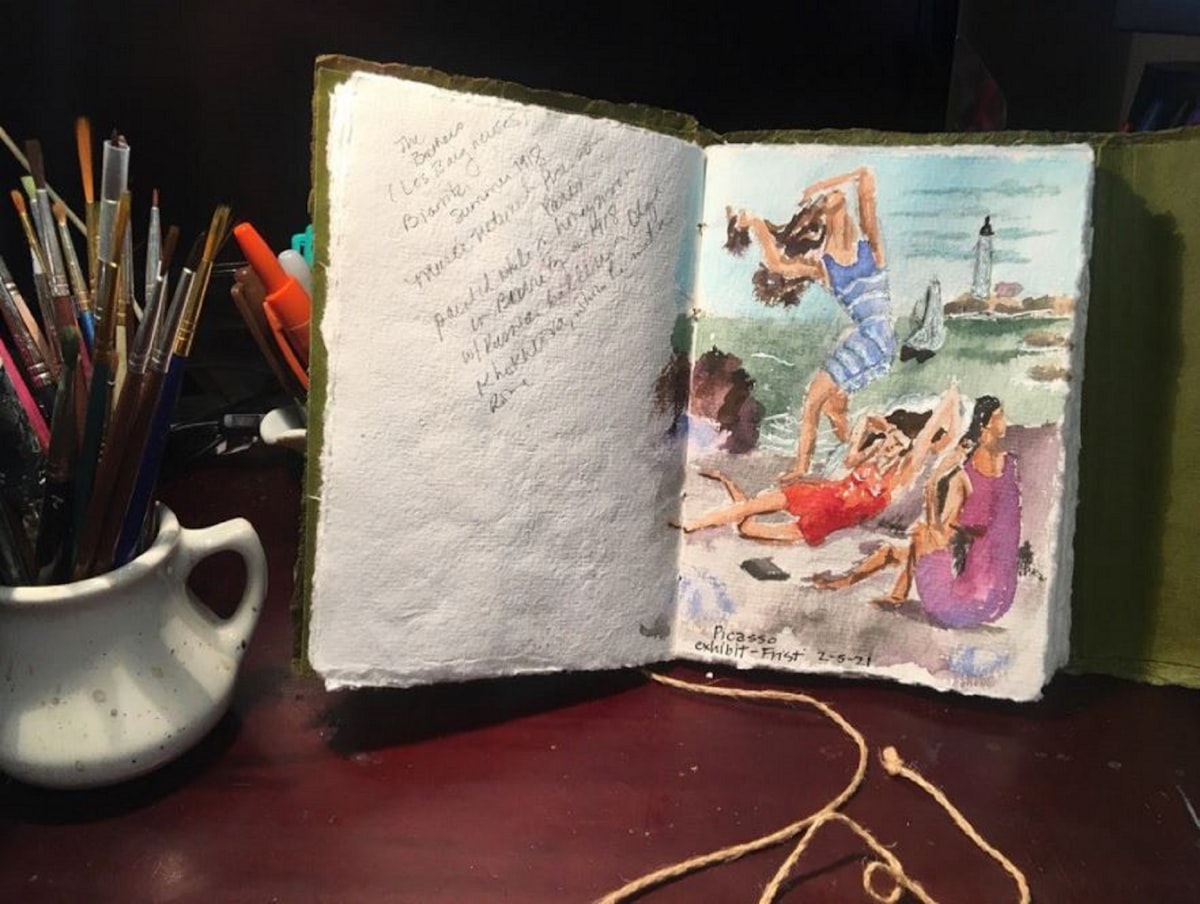
What Visual Journaling Actually Is
Visual journaling is the practice of using images, sketches, color, and other visual elements alongside written text in a journal. It is not art. It is not scrapbooking. It is a way of recording your inner life that does not rely entirely on words.
The defining feature is that the visual content carries meaning of its own, not as decoration. A small sketch of the view from your kitchen window is not there to make the page look nice. It is there because that view was part of your day, and a drawing of it preserves something a sentence would not.
If you have ever felt that words alone do not quite capture what you wanted to say in a journal, this is the practice that addresses that gap.
What You Do Not Need
Before listing what you need, it helps to clear away assumptions about what you do not.
You do not need to know how to draw. Stick figures, rough shapes, and badly proportioned objects all work. The point of a sketch in a visual journal is the act of looking, not the quality of the output.
You do not need expensive supplies. Most people start with a single notebook and one pen, then add things as they go. The supply lists you find online for art journaling are aspirational, not required.
You do not need a particular aesthetic. The polished pages on social media are curated for an audience. Your journal does not have an audience. Pages that look messy, partial, or strange are doing the practice correctly.
You do not need to commit to filling every page with images. A visual journal can hold mostly text with occasional sketches, or mostly images with occasional words. The mix is yours to find.
A Minimal Starter Kit
The simplest version of a visual journaling kit fits in a small bag.
One notebook with thick enough paper. Plain printer-grade journals will buckle under most paint and marker. A notebook with paper rated for mixed media — usually 100 gsm or higher — handles ink, light watercolor, and glue without falling apart. Dot grid or blank pages are more flexible than ruled pages, because they let you place text anywhere.
One reliable pen. A waterproof black fineliner is the most flexible single tool. It writes cleanly, holds up under light water-based color, and works for both writing and sketching. Pigma Microns and similar pens are common starting points, but any waterproof pen will do.
A small set of color. Colored pencils are the most forgiving option for beginners. They do not bleed through pages, they do not require water, and they are easy to control. A basic set of twelve is enough for years of work. If you prefer the look of paint, a small travel watercolor palette and a single water brush will get you started.
A glue stick. This unlocks the entire category of collected images — torn magazine pages, printed photographs, ticket stubs, anything flat enough to sit between pages.
That is the entire starter kit. You can add things over time, but adding more is not a prerequisite to beginning.
Setting Up the First Page
The first page of a new visual journal is often where people stall. The blank notebook feels precious, and the pressure to begin well can prevent beginning at all.
The simplest cure is to deliberately spoil the first page. Make a mark — any mark — that signals this notebook is not a museum piece. A messy color swatch, a quick sketch of whatever is in front of you, your name written awkwardly, a date scrawled in the corner. Anything that breaks the spell of the perfect blank page.
Some people leave the actual first page blank and start on page two. Others write a short note about what they hope this notebook will become. Both work. The point is to remove the weight of the opening before you sit down to record anything that matters.
What to Put on a Page
A visual journal entry can take many shapes. A few common patterns are worth knowing because they give you starting points when you do not know where to begin.
Text plus a small sketch. Write your entry as you normally would, then add a small drawing in the margin or at the end. The drawing can be of an object near you, a face you saw, the weather, a shape that matches your mood. It does not need to relate to the text directly.
A page divided in two. Half the page is for writing, the other half for an image — a photograph glued in, a magazine clipping, a sketch, a color study. The two halves comment on each other without explaining each other.
Color as feeling. Cover an area of the page with one or two colors that match how the day felt. Add a sentence or two about what was happening. The color carries the mood; the words carry the specifics.
A single image with one line beneath. A photograph or sketch fills most of the page. One handwritten sentence anchors it. This format is fast and works well when you do not have time or energy for a longer entry.
A grid of small things. Divide the page into six or nine boxes. Fill each box with one thing — a tiny drawing, a word, a color, a stamp. Each box is one piece of the day. This format is forgiving because no single box has to be much on its own.
You do not need to use a different format every time. Most people settle into two or three patterns that suit their handwriting, their materials, and the kind of attention they bring to the page.
Drawing Without Knowing How to Draw
The biggest barrier for new visual journalers is not materials. It is the belief that they cannot draw.
Almost everyone can draw enough for visual journaling. The drawings in a journal are not portfolio pieces. They are records of attention. A poorly proportioned sketch of a coffee cup, made in two minutes while the coffee cooled, is doing exactly what it should — it captures the act of having looked at the cup.
A few specific things help if drawing feels hard.
Draw what is in front of you, not from imagination. Imagination requires you to invent. Observation only requires you to look. Looking is easier.
Use contour lines instead of shading. A simple outline of an object is enough to record it. You do not need to render volume or texture unless you want to.
Draw small. A small drawing requires fewer decisions than a large one. A two-inch sketch can be done in a minute or two and feels much less precious than a half-page drawing.
Draw familiar objects. A pair of glasses on the table. A mug. A plant. The things you already know how to see are easier to draw than things you have to study.
Accept the result. A drawing in a journal is not for evaluation. It is for the record. If it looks awkward, it looks awkward. The next page will hold another drawing. The cumulative practice is what matters, not the individual page.
Using Color Without a Plan
Color is where many beginners get tangled. The fear is that they will pick the wrong colors, the wrong technique, and ruin the page.
A few starting principles make this easier.
Choose two or three colors at the start of an entry and stick with them. Limited palettes look more deliberate than full ones, and they remove the constant decision of what color to reach for.
Use color to fill space, not to render objects. A wash of yellow behind some writing changes the feeling of the page without requiring you to color anything specifically. A single colored shape next to a sketch adds presence without demanding accuracy.
Test colors on a back page first if you are using paint or markers. A small swatch in the back of the notebook tells you what a color actually looks like on this paper, and prevents surprises on the page you care about.
Let color overlap text. Writing through a wash of color, or laying color over writing, makes the two feel like part of the same surface rather than separate elements stacked on top of each other.
If you make a mark you regret, do not stop. Add another mark beside it, or write over it, or paste something on top. Visual journals get more interesting, not less, as imperfections accumulate.
Bringing in Images You Did Not Make
Not every image in a visual journal needs to be drawn. Many of the most interesting pages combine drawn elements with collected ones.
Photographs printed at any drugstore work well. A small photo from your phone, printed at wallet size, can sit on a page next to a few sentences. The photograph carries the visual specificity; the sentences carry what you cannot photograph.
Magazine pages, torn carefully, give you images and textures you would not produce yourself. The point is not to find a magazine photo that illustrates your entry. The point is to find an image that has presence — a color, a face, a shape — and place it on the page near your words.
Receipts, tickets, stamps, fragments of packaging, pressed flowers, small pieces of fabric — all of these can be glued into a journal. They preserve a sensory specificity that descriptions of them cannot match. A movie ticket from a particular Sunday holds something a paragraph about that Sunday does not.
You can also print pictures from the internet, screenshots from your camera roll, or pages from your own writing. Anything that has visual weight and can sit flat on a page is fair game.
Pacing the Practice
A visual journal does not need to be filled daily.
Some people use one as a primary journal and add visual content to most entries. Others keep a written journal for daily practice and use a separate visual journal less often, working through it more slowly with longer, more layered entries.
Both work. The most common reason people abandon visual journaling is overcommitting at the start — buying expensive supplies and trying to make every page look impressive, which is exhausting and quickly unsustainable.
A more durable approach is the opposite. Buy minimal supplies. Make small, fast entries. Let the practice settle into something you can do in fifteen minutes once or twice a week, and let it grow from there if it wants to.
If you skip a few weeks, do not catch up. Open the notebook on the next available page and put something down. The gap is part of the record.
A Few Common Pitfalls
A handful of mistakes recur for new visual journalers. Knowing them in advance makes them easier to avoid.
Buying too much before starting. A drawer full of unused supplies does not produce a journal. Buy a notebook and a pen. Use them. Add other things only when the existing ones feel insufficient for something specific.
Comparing pages to other people's. The visual journals on social media are filtered, photographed in good light, and curated. Real journals contain many pages that would never be posted. Comparison undermines the practice. Look at other journals for ideas, but do not measure yours against them.
Treating the journal as art. A journal is not a portfolio. It is a record. Pages can be ugly, partial, abandoned, or overworked. The internal pressure to make a journal look good will kill the practice faster than almost anything else.
Skipping writing entirely. Visual journaling is most powerful when image and word coexist. Pages without any text tend to lose their meaning over time, because the visual on its own does not carry enough context. Even a date and one sentence anchors an image.
Quitting because of one bad entry. Every visual journal has weak pages. The next page is always available. Bad pages are part of the record, not a reason to abandon the notebook.
What This Practice Becomes Over Time
A visual journal kept for a year is not the same kind of object as a written one.
You flip through it and you see the year visually before you read it. The colors of the pages change with the seasons. The faces and places that filled your attention reappear. The weight of certain weeks shows up in how dense the entries became, or how sparse.
This kind of record is harder to summarize than a written journal, but it is often easier to re-enter emotionally. Looking at a sketched page from a particular month brings back the feeling of that month in a way that reading a paragraph from the same time may not.
This is not because images are inherently more powerful than words. It is because images and words together hold more than either does alone. The practice you are starting is, at its core, an attempt to record your life with both — to use whatever serves the moment, without restricting yourself to one mode of attention.
A visual journal is not therapy, and it is not art. It is a way of paying attention to your own life and leaving evidence of that attention behind. That is the whole practice. Everything else — the materials, the techniques, the formats — is just the means.
Was this article helpful?
Thanks for your feedback!


