
Visual Diary Storytelling: Combining Images and Text in Your Writing Practice
Words alone do not always capture what you need to say. A visual diary — one that holds images alongside text — can reach places that writing alone cannot.
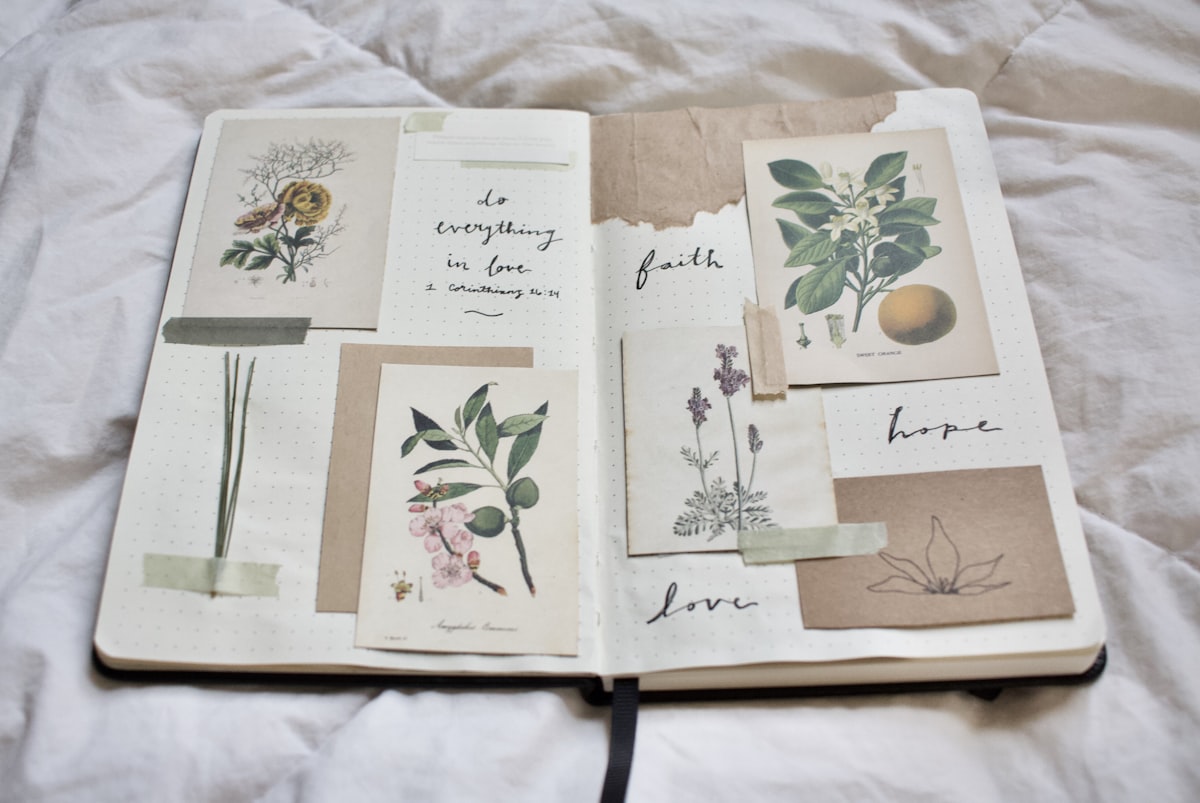
Not every thought arrives in words.
Some things come as images first — a color, a texture, a face, a fragment of something seen out a car window that stays with you all day. When you try to translate those impressions into sentences, something gets lost. The language is accurate but the feeling is not.
A visual diary is a practice that does not force that translation. It holds images alongside words, letting each carry what it can, without requiring either to do everything.
What a Visual Diary Is
A visual diary is not an art project. It does not require drawing ability, aesthetic sense, or any particular materials beyond what you already have.
At its simplest, it is a diary that includes images: photographs you have taken or printed, torn pages from magazines, sketches, postcards, ticket stubs, receipts with handwriting on them, paint swatches, anything that has visual presence on a page.
These images are not illustrations of the writing. They are not decorations. They are part of the record itself — things you chose to include because they meant something, even if that meaning is difficult to articulate.
The writing that surrounds them can be brief. Sometimes a few words are enough. Sometimes no words at all. The point is not to explain the image but to place it in context — in a particular day, alongside a particular mood, next to whatever else was happening.
Why Images Change What You Notice
There is a practical reason for adding images to a diary, separate from aesthetics: it changes what you pay attention to.
When you know you might photograph something for your diary — a corner of your kitchen, a leaf, the light on a wall — you move through your day with a slightly different orientation. You are looking for things worth noticing. That looking is itself the practice.
This is not the same as the constant documentation of social media, where images are collected and curated for an audience. A visual diary is private. The image does not need to be shareable or beautiful or interesting to anyone but you. You are not performing observation — you are actually doing it.
Over time, the images you collect in a visual diary reveal something about your particular attentiveness. You might discover that you are drawn to architecture, to people's hands, to the texture of ordinary surfaces. These tendencies are not trivial. They tell you something real about how you encounter the world.
Starting Simply
The simplest version of a visual diary requires two things: a blank notebook and a willingness to put things inside it.
Photographs printed at a drugstore or pharmacy. Pages torn from magazines that show colors or shapes that catch you. A drawing made in two minutes with a cheap pen. A receipt from somewhere meaningful. A piece of fabric or wrapping paper.
None of this requires preparation or special materials. It requires only the habit of setting things aside — the small act of noticing that something might be worth keeping.
You can work analog entirely, using a paper notebook with glue or tape to attach physical materials. You can work digitally, using an app that holds images alongside text, arranged across a visual canvas. Many people use both: a paper diary for tactile collected items, and a digital folder for photographs that accompany written entries.
The format is less important than the consistency. A visual diary that you return to weekly, even briefly, is worth more than an elaborate system you abandon after a month.
The Relationship Between Image and Word
When you place an image and a sentence on the same page, something interesting happens. Each one changes how you read the other.
A photograph of a gray afternoon outside your window, paired with the sentence "I have been avoiding a particular phone call," does something that neither the image nor the sentence does alone. The image holds the mood. The sentence names the specific truth. Together, they create a kind of precision that is hard to achieve through either medium separately.
This is the real possibility of visual storytelling in a diary: not illustration, but counterpoint.
You do not need the image to show what the words describe. You need the image to hold something the words cannot quite reach — the atmosphere, the texture, the visual feeling of the day. Then the words can do something equally specific: name what the image cannot say.
Try it deliberately. Find an image — any image — that captures something of how today feels. Paste or print or draw it. Then write beside it, not about it. Write about something true in your life right now, without necessarily referencing the image directly. Then look at what you have made.
Often, the image and the text will rhyme in ways you did not plan. The connection will be oblique and real at the same time. This is what visual diary entries can do at their best.
Practical Approaches
If you are uncertain where to start, a few specific approaches can make the practice more concrete.
The weekly visual summary. At the end of each week, choose one image that represents the week — not necessarily its most dramatic moment, but something that held its texture. Write a paragraph beside it. This takes fifteen minutes and produces a year of visual records.
The mood board entry. When you are feeling something difficult to name, collect three or four images that feel connected to that unnamed thing. Cut them from a magazine, print them from your phone, sketch them quickly. Arrange them on a page. Write a single sentence beneath. Often that sentence will name what you could not name before.
The paired photograph. Take a photograph of something in your environment — your desk, your coffee, the view from a window. Print it or keep it alongside your digital entry. Write what was happening around the moment you took it. Not what is in the image, but what surrounded it: what you were thinking, what had just happened, what you were about to do.
The found image. Keep a folder — physical or digital — of images that catch you: magazine pages, printed photos, screenshots, torn fragments. When you open your diary, select one from the folder without planning which one. Paste it in. Write whatever arrives. The randomness of the selection often produces unexpectedly honest entries.
The simple sketch. You do not need to draw well for a sketch to work in a diary. A rough outline of a face, a shape, a place is enough. The sketch does not need to look like its subject. It needs to feel like the act of attention you gave to that subject. That act is preserved in the drawing regardless of its technical quality.
What This Practice Does Over Time
A visual diary kept consistently becomes a different kind of record than a text-only diary.
It is more spatial. When you flip through its pages, you encounter images before you read words. You remember the visual quality of a period before you remember the specifics of what you wrote. This is not a limitation — it is a different kind of access to memory.
Many people find that visual diary entries are easier to re-enter emotionally than text entries. The image carries sensory information that language cannot fully store. Seeing the photograph of a particular afternoon, even years later, returns the feeling of that afternoon in a way that words about it may not.
The practice also tends to accumulate beauty, in a quiet way — not as an aesthetic goal, but as a byproduct. A diary full of images you chose because they meant something to you, arranged alongside words you chose for the same reason, becomes an object with its own presence. It is not a document. It is a record of a way of seeing.
No Audience Required
The most important thing to understand about visual diary storytelling is that it is not for display.
The images do not need to be photographically good. The layouts do not need to be designed. The writing does not need to be polished. A visual diary that looks chaotic and personal is doing exactly what it should. It is holding your actual experience, in the way your actual experience arrived — partial, textured, not fully resolved.
If you find yourself editing your visual diary for how it looks, or choosing images because they photograph well rather than because they mean something, pull back. The practice works only when it is honest.
Keep what catches you. Discard nothing too quickly. Trust that the things you feel drawn to keeping have a reason for being there, even if you cannot name it yet.
The page belongs to no one but you.


