
Journaling for Teens: How to Start a Practice That Feels Like Yours
A practical look at starting a journal as a teenager — how to keep it private, what to write when nothing comes, and how to stop it feeling like homework.
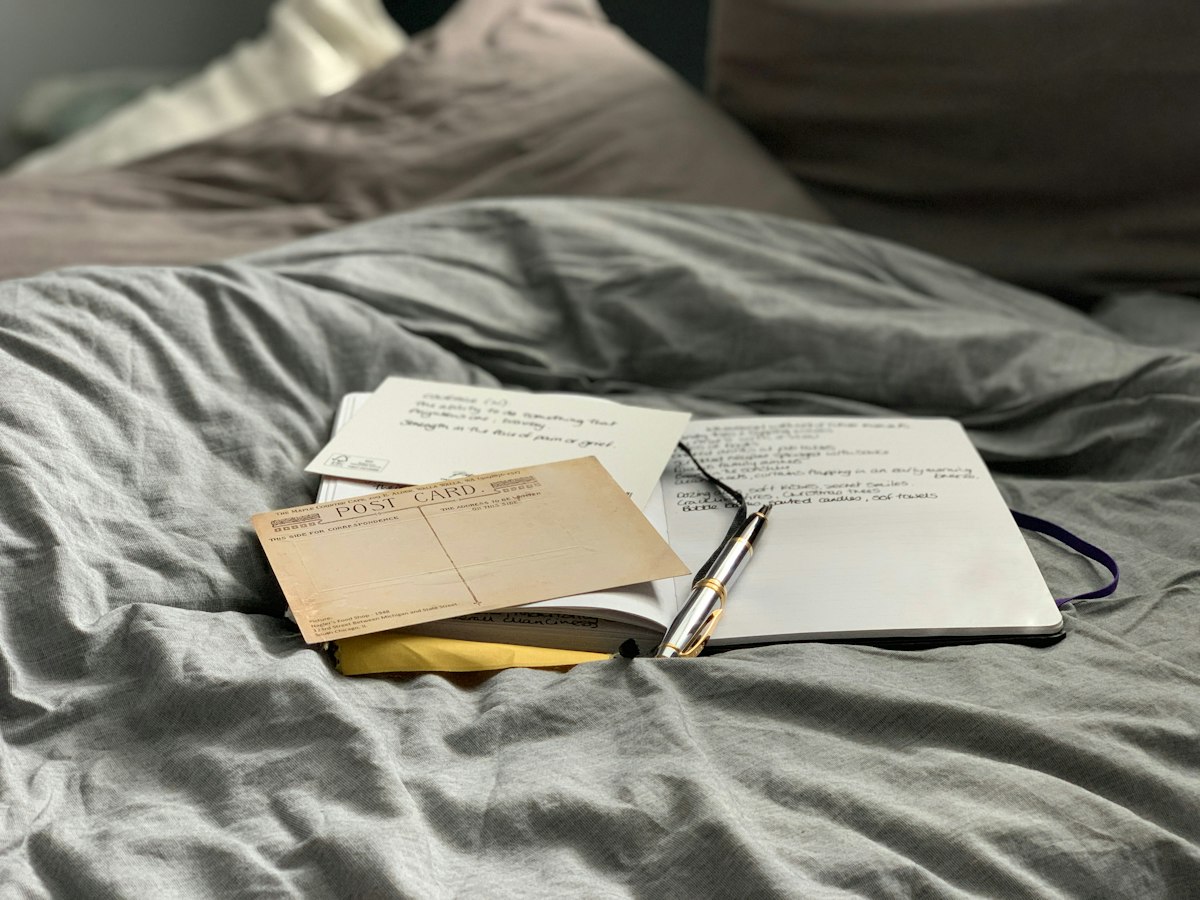
There is a version of journaling that gets recommended to teenagers, and it is usually the least appealing version available. Write every day. Reflect on your feelings. Track your gratitude. Hand it in on Friday.
If that is the only version you have encountered, it is reasonable to conclude that journaling is a wellness chore invented by adults who want you to process something.
The actual practice is stranger and more useful than that. A journal is a place where you get to think without an audience, which is close to the rarest thing available to anyone your age. Almost everything else you write — a message, a caption, a comment, an essay — is written with someone in mind. A notebook is the one place where nobody is reading over your shoulder and nothing has to be edited into a better version of itself first.
That is the whole appeal. Not self-improvement. A room with the door shut.
Why a Notebook Is Different from a Group Chat
You already talk about your life. The question is what a journal adds that a conversation does not.
The difference is that nothing in a journal has to land. A group chat, however close the friends in it are, is still a performance with an audience of five. You choose the framing. You leave things out. You wait to see how the first line goes over before deciding how much of the second one to send.
A page does not react. You can write something confused, or petty, or contradictory, or half true, and it simply sits there while you work out whether you meant it. Most of what is worth thinking about does not survive being said out loud on the first attempt.
There is also a practical thing that happens when you write something down. A worry that has been circling in your head for three days is usually shorter on paper than it was in your head. Sometimes it is four sentences long. Seeing that it is only four sentences long does not fix it, but it stops it feeling infinite.
Privacy Comes First
Nothing else in this piece matters if this part is not sorted out. A journal you suspect might be read is not a journal — it is a document written for whoever might find it, and you will feel the difference in every sentence.
So decide where it lives before you decide what goes in it.
If you share a room, or your things get moved around, a paper notebook in a desk drawer may not be a safe bet. A notebook that travels in your bag is often more private than one that stays at home. Some people keep the plain-looking notebook at home and the honest one elsewhere.
If you go digital, use something with a passcode or a lock, and make sure it is not syncing to a shared family account or backing up to a device someone else uses. The most common way a digital journal is discovered is not snooping. It is a notification appearing on the wrong screen.
A note about parents. Some parents read their children's journals, and some are open about believing they have the right to. If that is your situation, you are not being paranoid and you should plan around it. Write in a notebook kept somewhere else, or use an app they do not know exists, or write entries you do not keep. None of this is dishonest. Privacy is not the same as secrecy, and the ability to think unobserved is a normal thing to need at your age.
One more consideration, worth being clear about. If what you are carrying involves someone hurting you, or thoughts of hurting yourself, privacy is important but silence is not the goal. A journal is a good place to work out what you want to say. It is not the place to keep it permanently.
Lower the Bar Considerably
The reason most teenage journals stop after nine days is that the first entry set a standard nobody could keep.
The standard usually looks like this: a full page, written in the evening, in decent handwriting, covering the whole day and ending with something reflective. That is a demanding format, and it is not the one that survives a week with three deadlines in it.
Try the opposite. A single line counts. A list counts. Writing down what somebody said and nothing else counts. A page of complaining about one specific person counts. If the entry exists, the practice is working.
Frequency matters less than most advice claims. Writing twice a week for a year is a real practice. Writing daily for eleven days and then abandoning the notebook for four months is not, and the abandoning is usually caused by the daily part rather than by any failure of yours.
You also do not need to catch up. If there is a three-week gap, start from today. A journal is not a record you owe anyone, and there is no penalty for missing entries.
What to Actually Write
The blank page is the real obstacle. Here are a few starting points that tend to produce something.
Write what happened, plainly. Not how you felt about it, at least not at first. Where you were, who was there, what got said. Feelings tend to arrive on their own a few lines in, and they arrive more honestly when they were not the assignment.
Write the thing you cannot say. The reply you did not make, the opinion you kept to yourself, the thing about a friend you would not repeat. This is the highest-value use of a private notebook and it is the reason the privacy section came first.
Write a list. Things that are annoying you. Things you want. Songs you played more than once this week. Things you are worried about, in order of how likely they actually are. Lists are a legitimate entry, and on a tired evening they are frequently the only format that works.
Write about something that is not you. A film, a match, an argument you overheard, a theory about why something is the way it is. A journal does not have to be about your interior life. Some of the best ones are mostly about other things.
Write one line. On the days when nothing comes, one sentence about the day keeps the notebook in use. Over months, a run of single lines becomes a surprisingly detailed record.
The Part Where You Read It Back
This is the payoff, and it does not arrive quickly. It arrives around the six-month mark, the first time you read something you wrote and do not entirely recognize the person who wrote it.
You will find a crisis you cannot remember having. You will find someone described as a permanent fixture of your life who you have not spoken to since March. You will find a worry that occupied a full page and then simply resolved, without you noticing when.
That is genuinely useful information. Not because the past version of you was wrong, but because it shows you something you cannot see from inside a bad week: that states of mind move. The evidence is in your own handwriting, which is harder to dismiss than someone telling you it gets better.
Reading back is optional, though. Plenty of people write and never reread, and the practice still does its work in the moment. The record is a bonus rather than the point.
Some Honest Limits
Journaling is useful and it is not medicine.
It will not lift a depression, and it will not resolve anxiety that has settled in and stayed. It cannot do anything about a situation at home, a person who is making your life difficult, or something that happened to you that you have not told anyone about. Writing about those things can help you understand them and can help you work out what you want to say to someone. It is not a replacement for saying it.
There is also a way journaling can go wrong that nobody mentions. Writing the same painful thing repeatedly, in more and more detail, can deepen a groove rather than wear it down. If your entries have become the same three paragraphs about the same event, written on a loop, that is a signal to put the notebook down and talk to someone rather than to write more honestly.
A doctor, a school counsellor, a therapist, or an adult you actually trust. Those are the right routes for the heavy things, and choosing one of them is not a failure of the notebook.
Making It Yours
The reason to bother with any of this is that a journal is one of the few things in your life that nobody else gets to have an opinion about.
Nobody is going to mark it. Nobody is going to tell you the handwriting is untidy, or that you spent four pages on something small, or that you have not written since Tuesday. It does not have to be a nice notebook, and the first twenty pages do not have to be good.
Write in whatever register is actually yours. Swear in it if that is how you think. Use the slang. Draw in the margins. Put a ticket stub in it. Write an entry entirely in the form of a list of grievances. There is no house style and no one to disappoint.
The notebook that gets used is always the one that stopped feeling like an assignment somewhere around the fourth entry.
Start with tonight. Two lines about what happened is a beginning, and it is more than most people manage.
Was this article helpful?
Thanks for your feedback!


