
Blackout Poetry in Your Journal: Making Something New from Someone Else's Words
Blackout poetry turns a page of borrowed text into a poem by covering most of it. Here is how to make one in your journal, and why it helps on empty days.
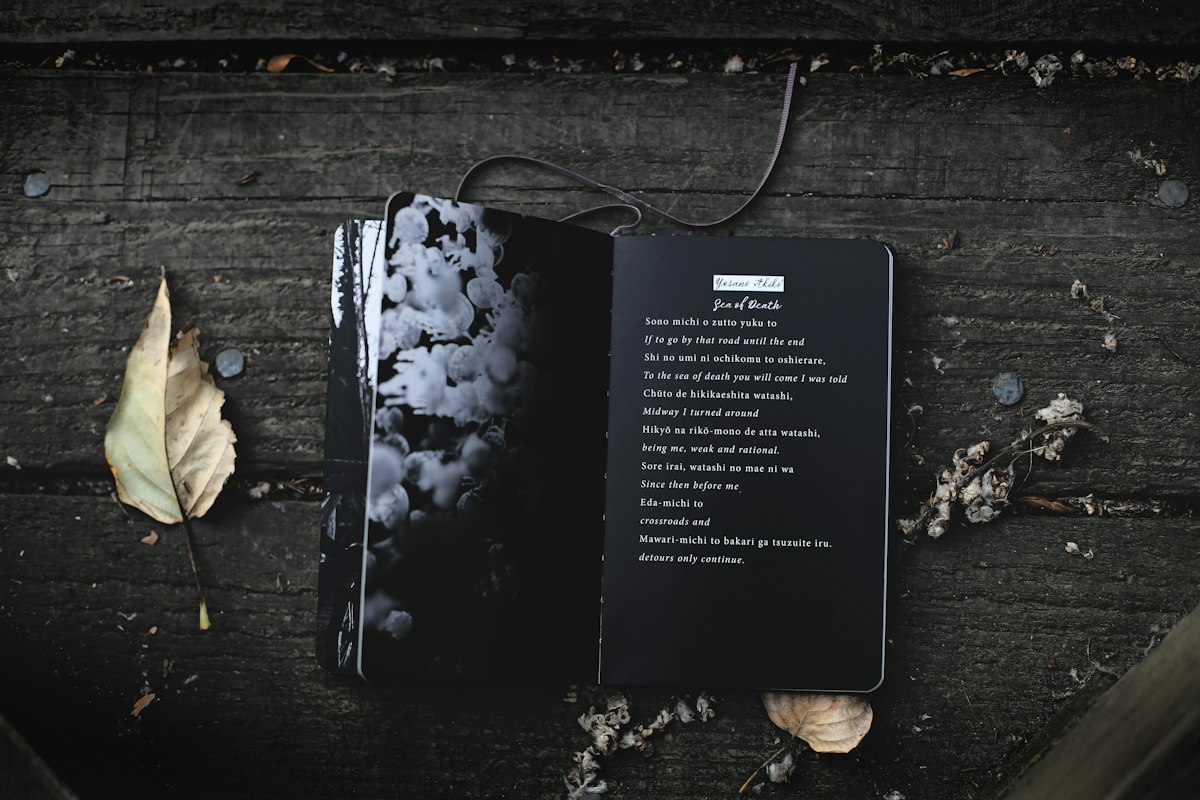
Blackout poetry begins with a page that already has words on it. A page torn from a paperback nobody wanted, a newspaper column, the back of a cereal box. You read it slowly, choose a handful of words that catch, and cover everything else in ink.
What is left is a poem. You did not write it, exactly. You found it, inside a text that was never meant to say what it now says.
For a journal, this is an unusually generous form. It asks nothing of you on the days when you have nothing to say. It gives you a page full of raw material and only one job: decide what to keep.
What Blackout Poetry Actually Is
The method has a few names. Blackout poetry, erasure poetry, found poetry. They overlap, and the differences matter mostly to people who write about poetry for a living.
The common idea is subtraction. Instead of filling a blank page, you start with a full one and remove most of it. The words you leave visible, read in order from top to bottom and left to right, form the poem.
Nothing is added. You cannot write in a word that is not already there. That constraint is the whole point. It takes the question "what should I say" off the table and replaces it with a smaller, more answerable one: "which of these words do I want."
Why It Belongs in a Journal
Most of what people make in a journal is additive. You bring the words, the page receives them. On a tired evening that can feel like being asked to perform.
Blackout poetry reverses the direction. The page brings the words. You respond to them. It is closer to reading than writing, which is why it works on days when writing feels out of reach.
There is also the matter of finishing. A journal entry can trail off. A blackout poem has a natural end: when the ink is dry and the page is dark, you are done. For people who rarely feel they have completed anything, that small closure is worth more than it sounds.
And the poems tell on you. The words you choose from a page about plumbing or weather or a stranger's divorce are rarely random. Over a few weeks, the pattern of what you keep becomes its own kind of diary entry, one you did not consciously write.
What You Need
Very little, which is part of the appeal.
- Source text. Pages you are willing to destroy. Old paperbacks from a charity shop, free newspapers, instruction manuals, junk mail, outdated magazines. One page per poem.
- Something to cover with. A thick black marker is traditional. A fine liner takes longer and gives more control. Acrylic paint, colored pencil, and correction fluid all work, and each changes the look.
- A way to keep it. Glue stick, washi tape, or a small envelope stuck inside the back cover. If your journal has thin paper, you may prefer to make the poem on the loose page and attach it afterwards rather than working directly in the book.
If you keep a digital journal, you can photograph a page, open it in any app that lets you draw over an image, and black out with your finger. The result is less tactile, but the thinking is identical.
How to Make One
The first attempt is usually the hardest, because the instinct is to read the page for meaning. Try not to.
Skim for words, not sentences. Run your eye down the page and let individual words stand out. Nouns and verbs tend to surface first. Ignore the story the page is trying to tell you.
Mark lightly. Circle or underline candidates in pencil. Choose more than you will keep. Fifteen or twenty words on a page is plenty to begin with.
Read your candidates in order. Top to bottom, left to right, as they fall on the page. Say them aloud if you can. Some will connect. Many will not.
Cut. Remove words until what remains reads as a single thought, or a single image, or a single question. A good blackout poem is often five to twelve words long. Shorter is usually better.
Commit. Go over the words you are keeping with a box or a firm underline so you do not lose them, then black out everything else. Work in one direction so you do not accidentally cover a word you meant to save.
Let it dry and read it again. It will feel different once the surrounding noise is gone.
Do not expect the first few to be good. Expect them to be finished, which is a different and more useful standard.
Choosing Source Pages
The page you start with shapes the poem more than any other decision.
Dense prose gives you the most choice. A novel page has several hundred words and a wide vocabulary. A technical manual has fewer, and a strange, flat tone that can produce oddly moving results.
Avoid books you love. Cutting into a book that matters to you tends to produce either reverence or guilt, and neither helps. The best sources are texts you feel nothing about. Discarded airport thrillers are ideal.
Vary the material. Legal notices, recipes, horoscopes, product descriptions. Each kind of text has its own vocabulary, and after a few poems from the same source you will start to recognize its limits.
Two practical notes. Do not black out library books or anything you have borrowed. And keep this for your own journal. Erasing a page of someone else's work for private use is fine. Publishing the result is a different conversation about permission, and one a private notebook does not need to have.
Beyond Black
The name suggests a marker and nothing else. In practice, the covering is where many people start to enjoy themselves.
You can draw instead of blacking out, turning the surrounding text into a landscape or a pattern, with the chosen words left as windows. You can use color, so the page reads as a block of blue with a few white gaps. You can leave a thin path between the words so the eye follows a line from one to the next.
You can also erase gently rather than cover. A light pencil shading over the unwanted words leaves them faintly visible, which gives the poem a ghost of its original context.
None of these are improvements over plain black. They are variations, and the right one is whichever you reach for without thinking too hard.
A Mood Check-In in Disguise
Try this for a week. Each evening, take any page and make a poem from it in under ten minutes. Date it. Do not try to make it about your day.
At the end of the week, read the seven poems in a row.
Most people find that the poems were about their week anyway. The words you keep from a page about lawn care are chosen by whatever is already occupying you. Blackout poetry tends to route around the part of you that composes a tidy diary entry and ask the quieter part what it noticed.
This is not therapy and it is not analysis. It is a way of catching your own attention off guard, and that is sometimes more honest than a direct question.
When It Goes Wrong
A few frustrations show up for nearly everyone.
Too many words. If the poem reads like a slightly damaged paragraph, you have kept too much. Cut it in half and see if it survives.
Forcing a theme. Deciding in advance that this poem will be about your mother, and then hunting the page for words that fit, tends to produce something strained. Let the page lead and see where it goes.
The poem that means nothing. Sometimes what is left is simply a handful of words with no connection. That is a complete and acceptable outcome. Not every page has a poem in it, and finding that out is part of the practice.
Neatness. Your blackout will be uneven. The marker will bleed. You will cover a word you wanted. None of this matters in a private journal, and the pages that look rough often read better than the careful ones.
Keeping Them
Where the poems end up depends on how you use your journal.
Some people give blackout poems their own notebook, a cheap one with thick pages that takes marker without bleeding through. Others tape each poem into the day's entry and write a line underneath about the source page and what they were thinking.
A third option is to copy the final words out by hand beneath the pasted page, so the poem exists twice: once as an object with its black field, and once as a clean line of text in your own handwriting.
If you make many, an index page at the back with the date and first word of each helps when you want to find one again.
A Quiet Place to Start
Find one page you do not care about. Read it once, without looking for anything. Then read it again, slowly, and notice which words you want to keep.
Keep them. Cover the rest.
That is the whole method. The page will do most of the work, and whatever is left when the ink dries will be yours.
Was this article helpful?
Thanks for your feedback!


