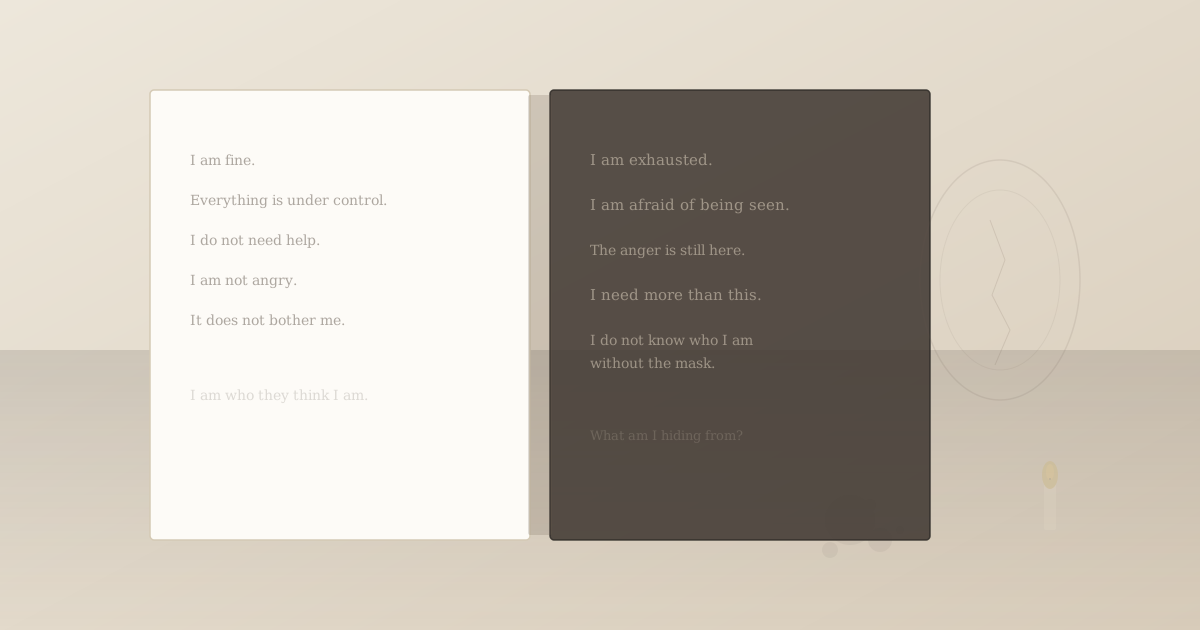
35 Journal Prompts for Working Through Guilt and Shame
Thirty-five prompts for writing honestly about guilt and shame — telling the two apart, tracing where they came from, and working out what is actually owed.

Guilt and shame are often spoken about together, and they often arrive together, but they are not the same thing and they do not respond to the same treatment.
Guilt is about something you did. It points at an action, a sentence, an omission, a choice. It can be accurate or inflated, but it has an object, and because it has an object it can in principle be addressed.
Shame is about what you are. It does not point at an action so much as at the person who took it. It says the mistake was not a mistake but a reveal, and that the thing revealed is unacceptable. Shame rarely wants repair. It wants you to disappear.
Writing cannot resolve either one on its own. What it can do is separate them, which is most of the work, because the two feelings tend to arrive braided together and the braid is what makes them so hard to carry. A guilt you can name is a guilt you can do something about. A shame you can see as shame has already lost some of its authority.
A note before you begin. If the shame you carry is connected to abuse, to something done to you rather than by you, or to a period you still cannot think about without your body reacting, these prompts are best used alongside a therapist rather than alone. The same is true if your guilt concerns harm you caused that is still ongoing, or if the writing turns toward thoughts of not deserving to be here. Journaling can support that kind of work. It is not a substitute for it, and used alone on the wrong material it can deepen a wound rather than clean it.
Before You Start
A few notes that make these prompts easier to work with.
Pick one prompt at a time. Most of these open wider than they look, and two in a sitting is usually one too many.
Write somewhere private. Guilt and shame are both quieter on the page when you are confident nobody will read it. The suspicion of an audience makes people write the defensible version of events rather than the true one, and the defensible version is useless here.
Expect the urge to argue your own case. People writing about guilt often slide into prosecution or defense within a paragraph. Neither is the task. The task is description first. Judgment, if it is still needed, can come later.
Do not aim to feel better by the end of the entry. Some of these prompts will leave you in the middle of something. That is a normal place for an honest entry to stop.
Telling the Two Apart
Before you can work with either feeling, you need to know which one you are holding. These first prompts are about sorting.
-
Write down the thing that is bothering you in one plain sentence. Then write a second sentence that begins with I did and a third that begins with I am. Notice which one feels truer, and which one feels louder.
-
When the feeling arrives, what does it want you to do? Guilt usually wants you to fix, apologize, or make up for something. Shame usually wants you to hide, withdraw, or go quiet. Write about what the feeling is asking of you.
-
Does the feeling have an edge or a floor? Guilt tends to be specific and bounded: this thing, that day. Shame tends to spread until it covers everything. Describe the shape of what you are carrying.
-
Imagine the thing you did had been done by a close friend instead. Write how you would describe it to a third person. Then compare that description with how you describe it to yourself.
-
Complete this sentence as many times as it keeps producing something: If people knew this about me, they would... Then read the list and mark which items are predictions and which are fears.
-
Which came first, the guilt or the shame? Some people feel guilty about a specific act and shame grows around it afterward. Others carry a shame that was there long before any particular act, and guilt simply attaches itself to whatever is nearest. Write about which pattern looks more like yours.
The Specific Thing
Guilt wants to be addressed precisely, and most of the time it is not. People carry a fog of wrongness for years without ever writing down exactly what they believe they did. These prompts ask for the exact account.
-
Write what happened as a plain sequence of events, in the order it occurred, without adjectives. What you did, what you said, what you did not do. No explanation yet.
-
Now write what you knew at the time. Not what you know now. What you understood about the situation, the other person, and the likely consequences in the moment you acted.
-
What were you trying to protect, get, or avoid when you did it? Nearly every regretted act was in service of something. Name the something without excusing the act.
-
Who was actually affected, and how? Be concrete and resist the urge to minimize or inflate. If you do not know how they were affected, write that you do not know.
-
What part of this is yours? Write the honest percentage if that helps, and then write what belongs to the other people, to circumstances, to timing, to luck. You are not allowed to claim all of it or none of it.
-
Is there a version of this where you did nothing wrong, and you are carrying guilt for someone else's choice, a reasonable decision that turned out badly, or simply for being present when something happened? Write about whether this guilt belongs to you at all.
-
What would a fair consequence for this actually look like? Not the punishment shame proposes. A proportionate one. Write it out and look at the gap between that and what you have been inflicting on yourself.
Where the Shame Learned Its Lines
Shame is almost always older than the thing it is currently attached to. It has a vocabulary, a tone, and a set of favorite accusations, and those were learned somewhere. Tracing the source does not dissolve the feeling, but it reframes it as something absorbed rather than something discovered.
-
What does the voice of shame actually say? Write its sentences out word for word, in its own tone. Then read them as if someone else had written them and describe the speaker.
-
Whose voice is it? Many people, on writing shame out in full, recognize a parent, a teacher, a sibling, a former partner, or a religious framework. Write about where you first heard this particular way of talking.
-
What were you taught was unforgivable growing up? Not what was explicitly said, but what you understood from how people reacted. Write the rules as you actually absorbed them.
-
Describe the first time you remember feeling that you, rather than something you did, were the problem. Where were you, how old were you, and what happened just before?
-
What did shame protect you from, once? Children often learn shame as a way of staying safe, staying loved, or staying small enough to avoid attention. Write about what the feeling might have been doing for a younger version of you.
-
What would the person who taught you this say about you now, and how much weight does their opinion deserve from where you are standing today? Answer the second part honestly even if the first part is painful.
The Cost of Carrying It
Guilt and shame feel like a form of accountability, which is how they justify their presence. Writing down what they actually cost tends to change how seriously you take the arrangement.
-
What have you not done because of this? A conversation, a return visit, an apology, a relationship, a job, a room you avoid entering. List the specific things rather than the general sense.
-
How does carrying this change how you treat the people who are not involved? Many people are shorter with their partner, warier with their friends, or harder on their children because of a weight that has nothing to do with any of them. Write about who else is paying.
-
What do you do to manage the feeling? Overwork, overgiving, apologizing for things that do not need apologies, drinking, staying busy, staying quiet. Describe the management strategies without judging them.
-
If the feeling has been doing its job as punishment, has the sentence been served? Write about how long you have carried this and whether any length of time would ever be enough by shame's own measure.
-
What would you be free to do if this lifted? Describe an ordinary week rather than a dramatic one. Notice which parts of the description feel like relief and which feel frightening.
Repair, Amends, and What Is Actually Owed
If guilt has an object, then it has a possible response. That response is not always an apology, and it is not always directed at the person involved. Sometimes the person is gone, or unreachable, or would be harmed by hearing from you. These prompts are about working out what, if anything, can be done.
-
If you could say one thing to the person affected, with no expectation of a reply, what would it be? Write it in full. Do not send it yet, and possibly do not send it at all.
-
What would genuine repair look like, as opposed to relief for you? An apology that mainly serves the apologizer is a different thing from one that serves the person harmed. Write about the difference as it applies here.
-
Is there anyone for whom hearing from you would make things worse? Be honest about whether reaching out is for them or for you. If it is for you, write about what else could serve that need.
-
If direct repair is not possible, what indirect form could it take? Some people change how they treat the next person in the same situation. Some give time or money to something connected. Some simply resolve to not do it again and keep the resolution. Write about what would feel proportionate and real.
-
What have you already done to make this right that you are not giving yourself credit for? Guilt has a habit of not keeping records of the repair, only the harm.
-
What would you need to see from yourself, over what period, to believe you had actually changed rather than just felt bad? Write the evidence you would accept. Then write about whether any of it has already happened.
Self-Forgiveness and What Remains
Self-forgiveness is often described as a single decision, which is why so many people conclude they are incapable of it. It is closer to a practice, and it does not require you to decide that what you did was fine. It requires you to decide that you are allowed to continue.
-
What are you afraid would happen if you forgave yourself? Some people fear they would do it again. Some fear it would mean the harm did not matter. Some fear losing the identity the guilt has given them. Write the fear plainly.
-
Write a description of yourself that includes this thing you did and is still a fair description. Not a flattering one. A fair one, the kind an honest friend who knew everything might give.
-
What do you believe about forgiveness when it is applied to other people? Write out your actual position, with its conditions and its limits. Then write about why you have been exempting yourself from it.
-
Separate what you can still change from what you cannot. Write two lists. Then write what it would mean to put the second list down, not because it does not matter, but because carrying it changes nothing for anyone.
-
Write a short letter from the version of you who has lived with this for another twenty years and made peace with it. Let them tell you what they did, what helped, and what they wish you would stop doing now.
Working With These Prompts
Start wherever you felt the flinch. The sections are ordered so they build, but the prompt that made you want to skip ahead is almost always the right one to begin with.
Keep sessions short. Writing about guilt and shame has a turning point past which examination becomes rehearsal, and that point is hard to notice from inside the entry. Fifteen to twenty minutes is usually enough. If you find yourself rewriting the same accusation in slightly different words, stop for the day.
Reread with care. Entries about shame can be hard to revisit, and reading them in the wrong mood can reopen things. If you reread at all, do it after some time has passed and preferably not late at night.
Do something ordinary afterward. Wash something, walk somewhere, make a phone call about nothing. The feelings these prompts stir up are heavy and they settle faster when you move.
If the Writing Makes It Worse
This happens, and it is worth knowing in advance.
For some people, writing about shame does not loosen it. It gives it a stage. The entries become longer and more detailed indictments, and the notebook turns into a place where the case against you is made more thoroughly than your mind managed on its own.
If you notice that, stop. It is not a failure of honesty or courage. It is a sign that this material, in this format, is doing something unhelpful right now.
A few adjustments that sometimes help. Write about the event in the third person for a while, as if describing someone else. Write only the repair prompts and leave the origin prompts alone. Set a timer and stop when it goes off, regardless of where the sentence is. Or put this list down entirely for a few weeks and write about something that has nothing to do with it.
And if what comes up does not respond to a change of format, take that seriously. Shame that will not shift, guilt that extends to things that were clearly not your fault, or thoughts that you do not deserve to be here are all worth bringing to a doctor or a therapist. They respond well to help. They respond poorly to being handled alone on paper.
A Few Honest Limits
A journal is a good place to see guilt and shame clearly. It is not, on its own, a good place to resolve them.
Writing will not undo what happened. It will not make the person you affected feel differently, and it will not reach back and change the voice that taught you to speak to yourself this way. What it can do is separate the feeling into its parts: an act that may need addressing, a verdict that may need questioning, and a tone that was learned and can be unlearned.
That is less than the promise usually attached to this kind of work. It is also more useful, because a guilt with an object can be acted on and a shame recognized as shame has already stopped being the whole truth about you.
Most of the time the work is small. You write down what happened. You notice which voice is speaking. You work out what is owed, you pay what you can, and you let the rest sit on the page instead of on your chest.
What you did is part of your story. It was never the whole of it.
Was this article helpful?
Thanks for your feedback!