
Timeline Journaling: Mapping Your Life Story on the Page
Timeline journaling arranges your life along a line instead of a page of prose. A practical method for seeing patterns that chronological entries hide.
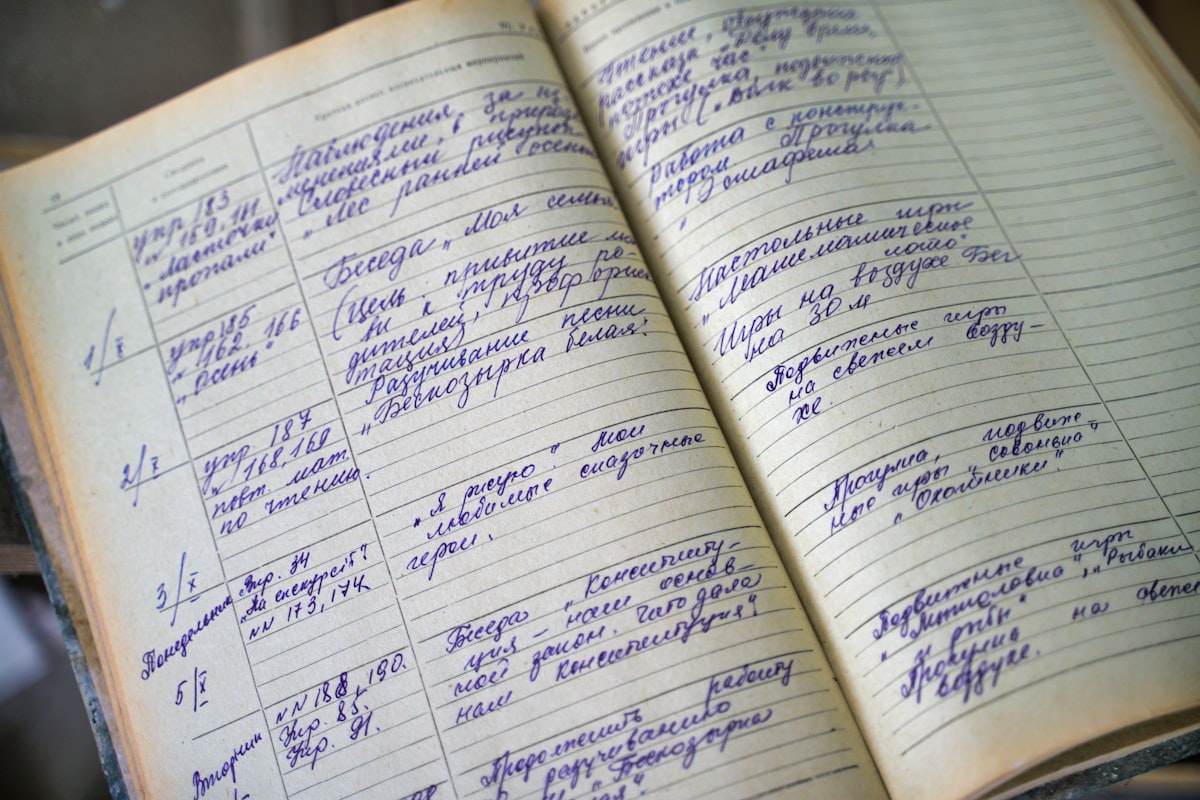
A journal read in order tells you what happened next. It is much worse at telling you what happened repeatedly.
This is a structural problem rather than a failure of writing. Entries arrive one after another, each absorbed in its own week, and the connections between them sit hundreds of pages apart. You can keep a journal for a decade and still not notice that every significant decision you made was preceded by the same six weeks of restlessness.
Timeline journaling is a way of changing the shape of the page so those patterns become visible.
What Timeline Journaling Is
Timeline journaling means arranging events along a line — usually horizontal, usually spanning a defined period — and marking them by position rather than writing them out in sequence.
The output is closer to a map than to an entry. A year across a double page, with events marked at the point where they fall. A childhood along a line with the houses you lived in above it and the people who mattered below it. A single hard month, marked hour by hour.
The technique is used in therapeutic work, in oral history, and in life review with older adults, generally for the same reason: laying events out spatially makes relationships between them apparent in a way that narration does not. Distance on the page becomes distance in time. Two marks close together are visibly close together, whether or not you had ever connected them.
You are not writing the story. You are looking at its shape.
Why the Format Reveals Different Things
Prose has a strong forward pull. Each sentence commits you to the next, and the natural product is a narrative — one thing led to another, and here is why.
A timeline removes that pull. Events sit next to each other without being caused by each other. What emerges instead is the material narrative usually hides.
Density. You can see which stretches are crowded and which are almost empty. Empty stretches are rarely uneventful; more often they are periods you have not thought about in years, and the gap itself is the finding.
Simultaneity. Prose covers one thread at a time. A timeline with several parallel rows shows what was happening in your work while that thing was happening at home. The overlap is frequently the explanation for something you have misattributed for years.
Rhythm. Marks spread along a line make cycles obvious. The recurring low point at the same time each year. The pattern of leaving jobs at roughly the same interval. The two-year rhythm you were entirely unaware of.
Proportion. A period that occupies enormous space in memory may occupy four months on the page. Seeing the actual span next to everything else adjusts the weight it carries, sometimes considerably.
Building a Basic Timeline
The method is straightforward, and the first attempt should be quick rather than careful.
Choose the span. A year, a decade, your twenties, the whole of your life so far, or a single defined period such as one relationship or one job. Wide spans reveal rhythm; narrow spans reveal cause. Start with something you can complete in one sitting.
Draw the line and mark the intervals. Across a double page if the notebook opens flat. Mark evenly spaced divisions — years for a decade, months for a year — before adding anything else. Even spacing matters, because unequal spacing will quietly reproduce the distortions of memory you are trying to see past.
Add events above the line. External, verifiable things: moves, jobs, illnesses, deaths, arrivals, decisions. Short labels, not sentences. Aim for speed and quantity.
Add internal states below the line. How you were, not what happened. "Anxious the whole spring." "Better than I admitted." "Numb." These are the entries you cannot verify and the ones that carry most of the value.
Go back and fill the gaps. Look at the empty stretches and ask what was happening then. Something was. The gaps usually fill in on a second pass, and what surfaces there tends to be the most interesting material on the page.
Write afterwards, not during. Once the line is finished, write half a page of prose about what you notice. This is where the technique produces its actual result. The timeline is the instrument; the writing is the reading.
Variations Worth Trying
The basic form is a starting point. These variants answer different questions.
Parallel rows. Three or four horizontal bands running across the same span — work, relationships, health, where you lived. Simultaneity becomes visible immediately. This is the most useful variant for anyone who suspects that one area of life has been driving another.
The emotional line. Instead of marks, draw a continuous line whose height represents how you were doing, then annotate the peaks and troughs. It produces a different kind of accuracy: less precise about events, much clearer about trajectory.
The zoom. Take one narrow section of a long timeline and rebuild it at higher resolution. A decade becomes a year becomes a fortnight. Zooming into a period you marked casually often reveals it was the point where several things turned.
The single-day timeline. A line covering twenty-four hours, marked with what you did and how you felt at each point. Useful for tracking energy, and unusually good at exposing the gap between how a day felt and how it was actually spent.
The forward timeline. The same structure extended past today. Mark what you expect, what is scheduled, what you hope. Reading the projected half against the recorded half is a blunt but effective exercise, since the past section shows how reliably your projections have held up before.
The thematic timeline. One thread only, across your whole life. Every place you have lived. Every friendship that mattered. Every time you changed your mind about something significant. Narrow scope, long span, and often the version that produces the clearest single insight.
When to Use It
Timeline journaling suits particular moments better than daily practice.
It works well at a threshold — leaving a job, ending or beginning a relationship, a birthday that has landed heavily, a move. At these points the question is usually not what happened this week but what the last stretch actually was, and a timeline answers that faster than rereading years of entries.
It works when you suspect a pattern but cannot demonstrate it. The vague sense that this has happened before becomes checkable once the instances are marked on a line.
It works as an annual review, and better than most annual review formats, because it resists the highlight-reel effect. A year drawn out month by month includes the dull stretches and the abandoned plans, which a list of achievements does not.
It also works as an introduction to your own journals. If you have years of entries you have never reread, building a timeline from them is a manageable way in — you skim for events and marks rather than reading every page.
It is a poor fit for daily use. The format needs a span to work on, and a single day rarely supplies one.
Practical Notes
A few things that make the difference between a useful timeline and an abandoned one.
Use a double-page spread at minimum. Timelines fail mainly through lack of room, and a cramped line cannot be added to later.
Draw in pencil first if the notebook matters to you. Events will arrive out of order and want moving.
Do not aim for completeness. A timeline with thirty marks is more readable than one with two hundred. You are looking for shape, and shape is easier to see when the page is not full.
Date the timeline itself. A life timeline drawn at thirty and another at forty-five are different documents, and the differences between them — what you included, what you left out, what you reweighted — are informative on their own.
Expect the dates to be wrong. Memory for sequence is more reliable than memory for date. Approximate positioning is sufficient; the relationships between marks are what you are reading, not the calendar accuracy.
What It Does Not Do
Mapping a life on a page can feel conclusive, and it is worth being clear that it is not.
A timeline is a selection made by you, today, and it reflects what you currently consider significant. Draw the same span next year and the marks will differ. The pattern it shows is a real pattern in your account of events, which is not quite the same as a pattern in events.
It can also be difficult in a way that ordinary journaling is not. Laying out a period of loss or a stretch of years that went badly puts everything in view at once, without the pacing that prose provides. If a period is still raw, a timeline of it is likely to be the wrong tool at the wrong time. Working through material like that is often better done with a therapist than with a notebook, and a journal does not replace one.
Used at the right moment, though, it does something few journaling techniques manage. It shows you a decade in a single glance, including the parts you had quietly stopped counting.
Most of what it reveals was already written down somewhere. It was just spread too thin to see.
Was this article helpful?
Thanks for your feedback!


