The Mental Health Benefits of Gratitude Journaling: What the Research Says
Gratitude journaling has real effects on mental health, but the research is more nuanced than the marketing suggests. A careful look at what the evidence actually shows.
Gratitude journaling has become one of the most heavily marketed wellness practices of the past decade. The promise is simple and appealing: write down three things you are grateful for each day, and your mood, sleep, relationships, and outlook will improve.
Some of that promise is supported by research. Some of it is not. And some of what the research does show is more conditional and less dramatic than the cultural conversation around gratitude suggests.
This is worth taking seriously if you are considering starting a gratitude journal, or if you have tried one and felt that it did not work for you. The practice has real effects on mental health for many people, but the conditions under which it works — and the conditions under which it does not — are not the same.
What the Early Research Found
The modern study of gratitude as a psychological practice begins largely with Robert Emmons and Michael McCullough, whose work in the early 2000s introduced gratitude journaling to a wider audience. In their best-known study, participants who wrote weekly lists of things they were grateful for reported greater wellbeing, more optimism about the coming week, and even some physical improvements compared to participants writing about hassles or neutral events.
Those findings, replicated in various forms over the following years, drove a wave of popular interest. Three-good-things exercises, gratitude apps, and structured gratitude journals followed.
The underlying claim — that deliberately attending to good things in your life can shift your overall outlook — is reasonable, and there is solid evidence behind it. But the magnitude, durability, and conditions of that effect have been revised significantly since the early studies.
What More Recent Reviews Show
Larger meta-analyses, looking across many studies rather than individual ones, tend to find that gratitude interventions do produce small to moderate improvements in wellbeing and in symptoms of depression and anxiety, on average. They are not nothing. They are also not the transformations sometimes described in popular books.
A few patterns recur across the more careful reviews.
The effects are usually small to moderate, not large. Gratitude journaling tends to nudge wellbeing in a positive direction rather than restructure mood entirely. For people already in good mental health, the effect is often modest. For people in significant distress, it can be more meaningful — but in those cases, it is typically more useful as a supplement to other support, not a replacement for it.
The effects fade without continued practice. Many studies show benefits during the active intervention period that diminish once participants stop. This is true of many psychological practices, and it suggests that gratitude journaling is more like exercise than like a one-time treatment.
The comparison condition matters. When gratitude writing is compared to writing about neutral topics, it usually shows benefits. When it is compared to other active positive practices — like acts of kindness, self-affirmation, or savoring — it often performs about the same. Gratitude is not uniquely powerful. It is one of several practices that direct attention toward positive aspects of experience, and any of them tends to help if done consistently.
The effects on physical health and sleep, sometimes claimed in popular writing, are weaker and less consistent than the effects on subjective wellbeing. Some studies show improvements; others find no significant change.
Why It Tends to Work for the People It Works For
When gratitude journaling helps, the mechanisms are not mysterious.
Attention is selective. Most people, most of the time, notice what is wrong, what is missing, what needs to be fixed. This bias is partly evolved and partly learned, and it can become extreme during periods of stress or low mood. A regular practice of deliberately scanning for things that went well, things you appreciated, or people who showed up for you offsets that bias, at least during the time you are doing it.
Writing things down makes them more durable. A noticed good moment that is not recorded tends to fade quickly. The act of writing extends the moment, gives it a small physical presence, and makes it accessible to you later when you re-read.
Recording gratitude builds an evidence base against catastrophizing. When low mood tells you that nothing has been working, that you have been miserable, that there is no point — a journal of small good things contradicts that story. It does not erase the low mood. It just makes the totalizing version of it harder to fully believe.
Gratitude often involves other people, and noticing other people involves noticing relationships. Several studies have found that gratitude practices are associated with stronger relationships and increased prosocial behavior. The effect may be partly about how gratitude redirects your attention toward the support you already have.
Why It Does Not Work for Everyone
Despite the marketing, gratitude journaling is not universally helpful. There are clear situations in which it fails, or even makes things worse.
For people in significant depressive episodes, forced gratitude can feel hollow at best and shaming at worst. When you are genuinely low, being told to list three things you are grateful for can feel like one more demand you are failing to meet — proof that even something simple is beyond you. The internal response is often the opposite of what the practice intends: a kind of bitter compliance, where you write the list but feel nothing.
For people who use gratitude to suppress legitimate difficulty, the practice can become a way of avoiding rather than processing. If every entry is "I am grateful for my family, my job, my health," and meanwhile you have been carrying real grief or anger that you never write about, the gratitude journal is not making you happier. It is helping you not look at what hurts.
For people whose lives include genuine injustice or hardship, premature gratitude can be a form of self-silencing. There is a difference between acknowledging good things and pretending difficult things do not exist. A practice that demands the first while implicitly forbidding the second can become quietly oppressive.
The research is consistent with these clinical observations. Gratitude interventions tend to work best for people who are functioning reasonably well and want to build on that. For people in active distress, other approaches — therapy, behavioral activation, treatment of underlying conditions — usually take precedence.
What Honest Gratitude Writing Looks Like
The version of gratitude journaling that tends to produce real effects looks different from the version sold in pre-printed gratitude journals.
It is specific rather than generic. "I am grateful for my family" is less useful than "I am grateful that my brother called this morning without me asking, just to check in." The specificity is what makes the noticing feel real. Generic entries tend to fade into rote compliance after a week or two.
It includes the reason, not just the object. Writing why you appreciated something — what it meant, what made it possible, what would be missing without it — does more than naming the thing alone. The reason is what extends the practice beyond list-making.
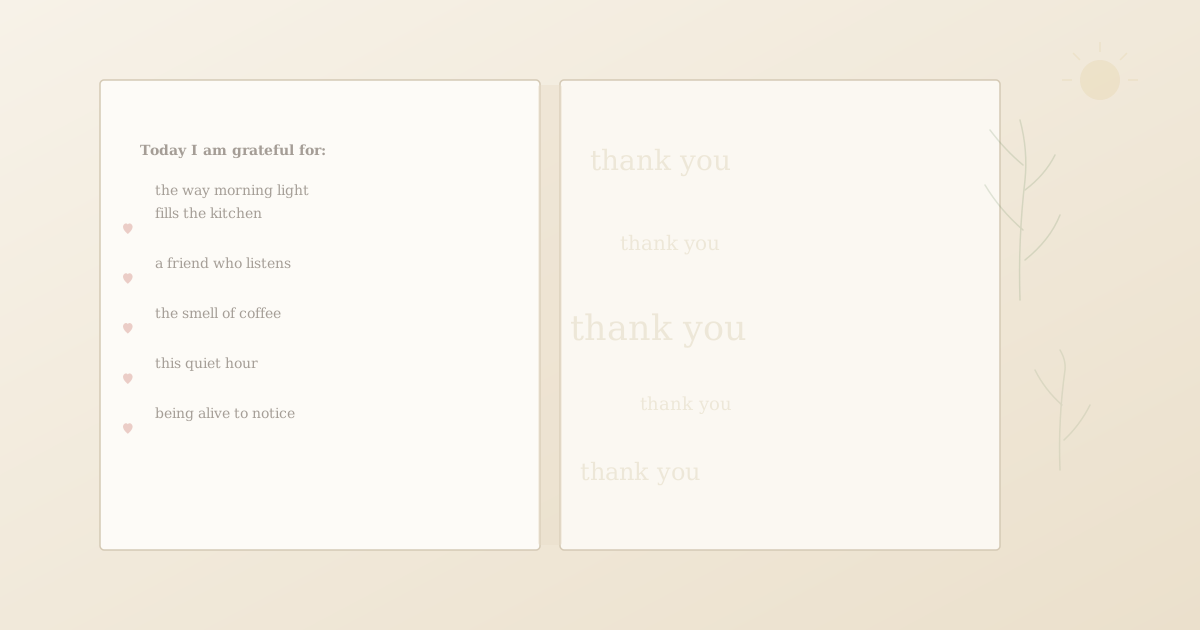
It allows for difficulty alongside appreciation. An entry that says "today was hard, and I also noticed the way the light came through the kitchen window at four" is doing both kinds of honest noticing. The gratitude does not erase the hardness. The hardness does not invalidate the gratitude. Both belong on the page.
It does not require feeling grateful. Many people assume that if they do not feel a warm emotional surge while writing, the practice is not working. The act of attending is the practice. The feeling is sometimes there and sometimes not, and the practice is still doing its work either way.
It avoids the same items every day. "My health, my home, my family" written every morning for a month becomes invisible. Practices tend to lose their effect when they become automatic. Forcing yourself to notice new things keeps the attention live.
A Sustainable Frequency
The original studies sometimes used daily gratitude writing, but more recent research suggests that less frequent practice may actually be more durable.
Several studies have found that weekly gratitude entries produce effects similar to or greater than daily entries, partly because daily practice can become routine quickly, while weekly practice asks you to think more carefully about a longer period. The novelty stays higher. The act of writing stays meaningful.
For many people, two or three times a week is a reasonable middle ground. Often enough to keep the attention shifted in a useful direction; not so often that the entries become reflex.
If you are starting from no practice at all, weekly is a better entry point than daily. You can always do more if it suits you. Starting at daily and burning out within a month is a more common outcome than starting weekly and building from there.
When the Practice Is Failing You
If you have been keeping a gratitude journal for several weeks and it does not seem to be helping — or seems to be making things worse — that is information worth taking seriously rather than ignoring.
Common signs that the practice is not serving you well include feeling worse after writing rather than better, finding that entries feel forced or insincere, noticing that the journal is becoming a place where you cannot tell the truth about how you are, or feeling that you are being told by your own writing to stop having the feelings you actually have.
In any of these cases, the answer is not to push harder. It may be that gratitude is not the right practice for the current period of your life. It may be that an open, less structured journal would suit you better — one where appreciation can appear when it appears, alongside difficulty, anger, confusion, and everything else.
It may also be a signal that what is happening is beyond what a journal can hold. If a gratitude practice is not lifting a low mood that has been around for weeks, the more useful question is not what to write differently. It is whether to talk to a doctor or therapist.
A Note on the Wellness Marketing
The gap between what the research shows and what the wellness industry claims about gratitude is significant.
The claims you sometimes see — that gratitude journaling rewires your brain, dramatically improves health, transforms relationships, increases income, or cures depression — outrun the evidence considerably. Some are based on misreadings of small early studies. Others are pure marketing.
The honest picture is more modest. Gratitude journaling, done consistently, tends to produce small to moderate improvements in subjective wellbeing for many people. It works best when it is one of several practices, not when it is asked to do all the work. It is most powerful when it is specific, honest, and able to coexist with difficulty.
This is still worth doing. A small reliable shift in how you attend to your life, sustained over months and years, is meaningful. It just is not magic, and treating it as magic leads to disappointment and abandonment.
A Plain Version of the Practice
If you want to start a gratitude journal and you want a version of it that is supported by what the research actually shows, the practice is small.
Two or three times a week, write briefly about two or three specific things you noticed, appreciated, or were glad of. Include why. Allow yourself to write about difficulty in the same notebook, on the same page, without feeling that one cancels out the other. Skip days when it feels false. Resume when it does not.
That is the whole practice. It is not impressive. It does not require a special notebook or a structured template. It is the version most likely to last more than a month, and the version most likely to produce the small, real effects the careful research describes.
A diary is not therapy, and a gratitude practice is not a cure. Both can be quietly useful, in their own way, for the long work of paying honest attention to your own life. That is what the evidence actually supports. It is enough.
Was this article helpful?
Thanks for your feedback!